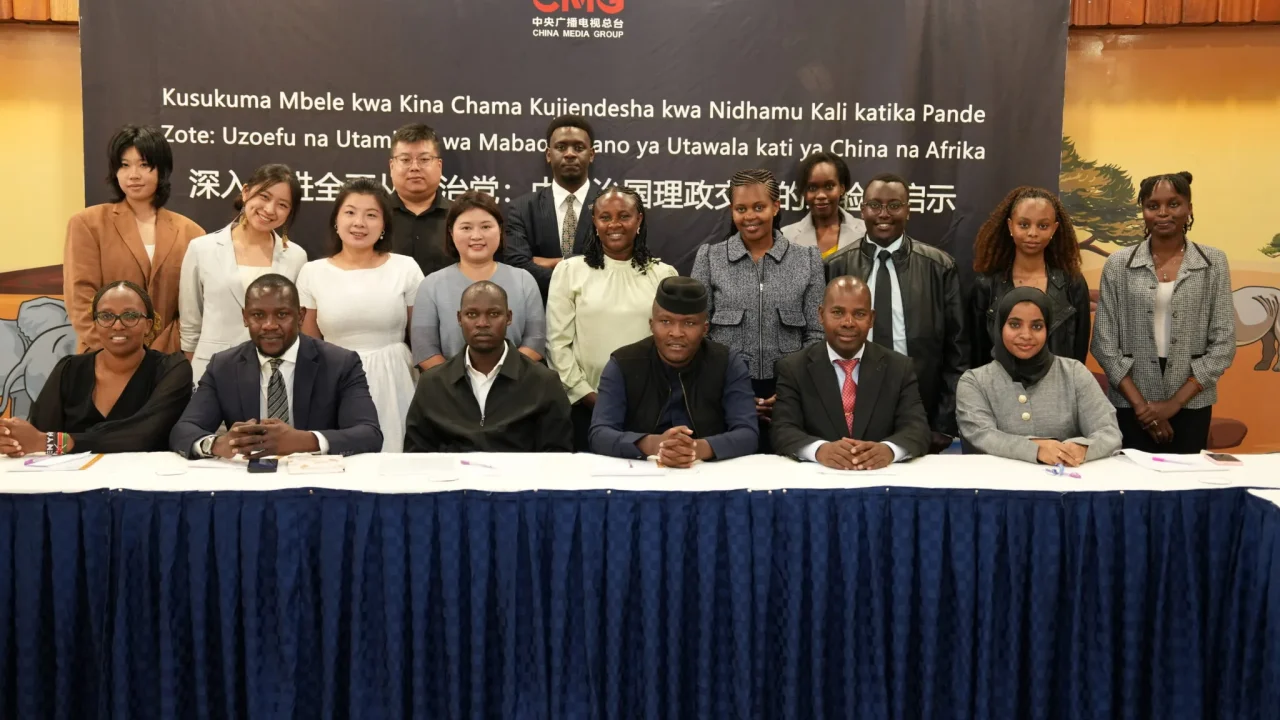
A Nairobi governance discussion explored lessons African countries could adapt from China.
Scholars and political leaders call for stronger accountability while urging African governments to protect constitutional rights and public participation.
Kenyan scholars and political leaders have urged African governments to learn from China’s anti-corruption model while safeguarding constitutional rights. They called for stronger institutions, political discipline and accountability during a round-table discussion in Nairobi.
The discussion examined the Communist Party of China’s approach to leadership, internal oversight and long-term planning. However, University of Nairobi Associate Professor Patrick Maluki warned against importing China’s political system wholesale.
Maluki, who chairs the Foreign Service Academy, said China’s governance reflects its distinct history and political context. African governments should therefore adapt useful practices to local circumstances while protecting political pluralism and public participation.

China’s anti-corruption model offers accountability lessons
Kenya Methodist University lecturer Rebecca Ndeto urged governments to study China’s approach to investigating officials across seniority levels. She argued that institutional decline and unchecked corruption prevent development.
China’s campaign under President Xi Jinping targets both senior officials and lower-ranking public servants. Its commonly used description, “tigers and flies”, refers to those different levels of authority.
Ndeto said governments must show the resolve to investigate their own officials, regardless of rank. She also argued that firm institutional discipline and accountability can build public trust for long-term development programmes.
Meanwhile, Maluki identified organisational discipline, planning and institutional oversight as areas that African countries could learn from. However, he cautioned against merging political parties with the state or treating personal loyalty as organisational discipline.
He also warned that political dominance should not become a substitute for stability or weaken constitutional safeguards.
Institutions and citizens must guide governance
Maluki compared the political experiences of Kenya, Tanzania and Uganda to question assumptions about continuity and competition. Neither approach alone guarantees development, he argued. Instead, effective institutions must use power responsibly and turn national resources into public benefits.
He said people-centred governance should improve access to essential services, jobs and affordable living costs. It should also uphold integrity in public office and give citizens ways to seek redress.
United Democratic Alliance youth affairs representative Kipkorir Brian said the CPC’s organisational history offered lessons for African political parties. Similarly, UDA youth leader Kidi Mwaga said political parties should advance citizens’ aspirations.
Mwaga identified poverty, ignorance and disease as challenges requiring leadership that puts citizens first. He also argued that government legitimacy rests on public support and consent.
National Youth Leader Kariuki Ngunjiri welcomed the exchange as an opportunity for young politicians to understand organisational discipline. Participants called for further China-Africa exchanges focused on locally appropriate practices, stronger accountability and development that benefits ordinary citizens.