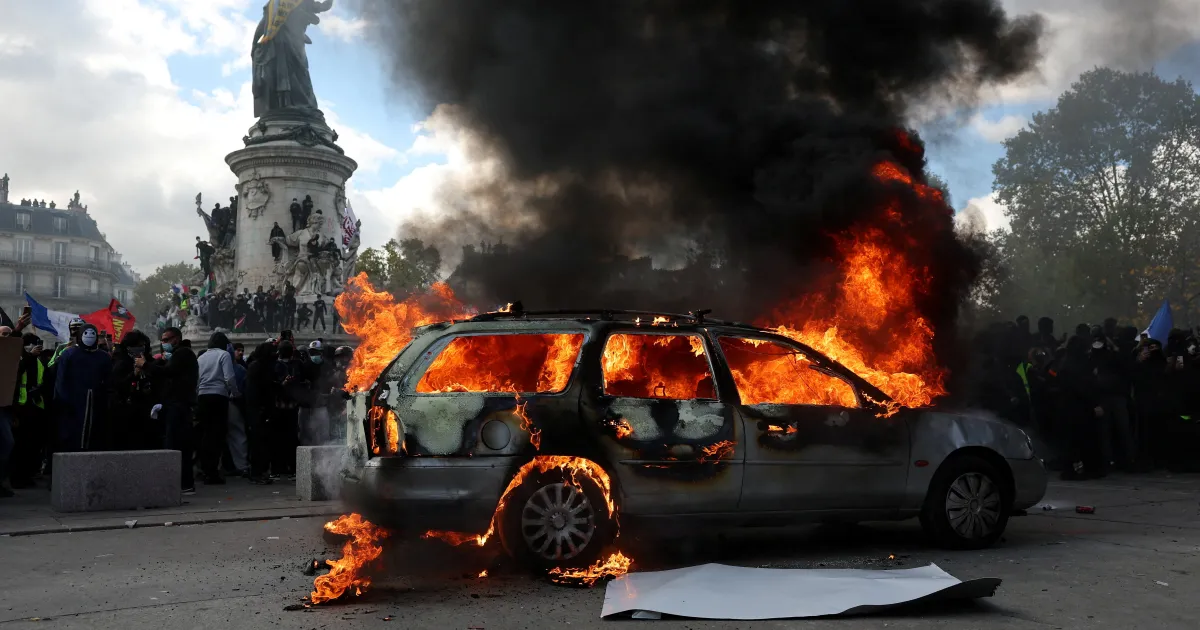
Violent clashes, fires and looting marred demonstrations across France on October 17, 2026, as hundreds of thousands of people marched against rising living costs and poor conditions in schools. [Photo courtesy: Reuters]
Europe is experiencing a wave of protests driven by economic frustrations, education concerns and growing anger towards political leadership. However, viral social media videos can make separate demonstrations appear to be one coordinated uprising.
From violent clashes in France to student-led demonstrations in Albania, unrest has exposed deep divisions between citizens and their governments. Although the protests share some grievances, each country faces its own political and economic challenges.
France: Cost-of-Living Anger Fuels Protests
France has witnessed major demonstrations over rising living costs, public services and government policies. Protests on October 17, 2026, drew hundreds of thousands of people nationwide.
According to Le Monde, authorities estimated turnout at approximately 550,000, while organisers put the figure at 800,000. Some demonstrations escalated into clashes, arson and looting, prompting arrests and a heavy police response.

Nevertheless, not all demonstrators participated in violence. Many joined peaceful marches to express concerns about living costs, education and government decisions.
Albania: Student Protests Challenge Edi Rama
In Albania, student-led demonstrations in Tirana entered their sixth consecutive day on October 18. Protesters demanded Prime Minister Edi Rama’s resignation while raising concerns about education costs, corruption and limited employment opportunities.
The movement also reflects opposition to a controversial luxury tourism development linked to an investment firm founded by Jared Kushner, US President Donald Trump’s son-in-law.
Clashes between protesters and police resulted in damaged buildings, fires and injuries. Police responded with tear gas, water cannons and other crowd-control measures. However, Rama rejected calls to resign as demonstrations continued.
Italy and Other European Countries
Italy has also experienced demonstrations and clashes linked to broader social and economic concerns. Meanwhile, reports have highlighted youth-led protests in countries including Belgium, Portugal and Spain.
However, these movements do not necessarily share the same immediate causes. Housing affordability, education costs, employment prospects and political accountability vary across countries.
One Crisis, Different Battles
The similarities between these demonstrations have fuelled claims of a coordinated European uprising. However, the available reporting points to distinct movements shaped by local grievances rather than one central organising force.
Social media has amplified the images, making events in different countries appear closely connected. Yet similar frustrations do not automatically prove coordination.
Ultimately, Europe’s protests reflect growing pressure on governments to address citizens’ concerns. Whether that pressure leads to policy changes or further unrest will depend on how individual governments respond.