

Kenya’s health authorities respond to the first imported Ebola case

NAIROBI, Kenya — Kenya is racing to contain its first confirmed imported case of Bundibugyo Ebola, after a Kenyan citizen died in Nairobi.
Health Cabinet Secretary Aden Duale confirmed the case on Tuesday, October 6, 2026. The patient had lived in the Democratic Republic of Congo (DRC) for seven years before returning to Kenya.
The patient had fallen ill about a month earlier while in the DRC. He received treatment at several health facilities before travelling by road to Kampala, Uganda.
He later boarded Jambojet flight JM 8523 from Entebbe to Nairobi. The flight arrived at Jomo Kenyatta International Airport on Saturday, October 3.
How Kenya Detected the Case
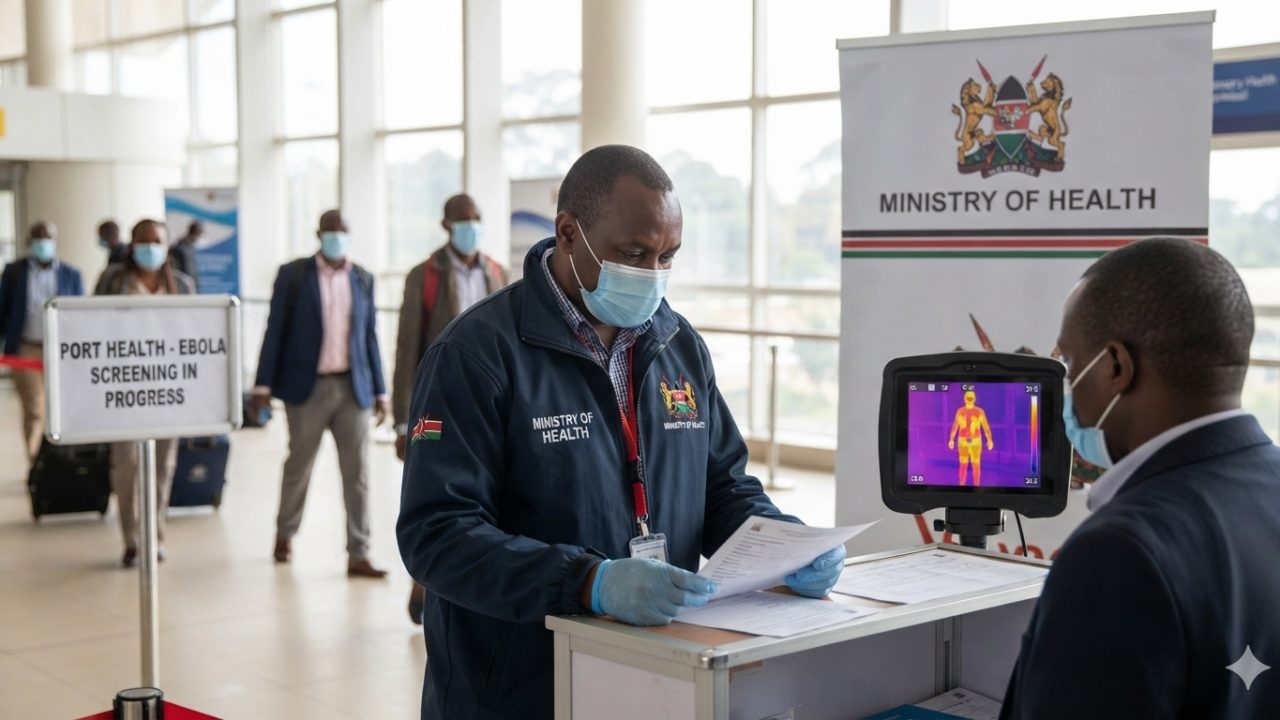
The patient underwent routine public health screening at JKIA before clearing immigration. He was then taken directly to Nairobi Hospital by a relative and a friend.
At the hospital, doctors isolated him after he developed symptoms consistent with viral haemorrhagic fever. These included fever, severe fatigue, weakness, muscle pain and bleeding under the skin.
Laboratory testing at the National Virology Reference Laboratory and KEMRI confirmed Bundibugyo Ebola virus disease.
Despite receiving supportive treatment, the patient died on Monday night. Authorities are preparing a safe and dignified burial under Ebola public health protocols.
The Race to Trace Every Contact
Kenyan health officials have identified 28 people who had close contact with the patient. They include family members and healthcare workers.
Authorities are also tracing 23 passengers and four crew members who travelled on the same flight.
Jambojet has confirmed that it is working with the Ministry of Health and Port Health Services to identify and manage people who may have been exposed.
The airline has urged the public to rely on official information as the contact-tracing exercise continues.
Why Bundibugyo Ebola Presents a Challenge
The case involves the Bundibugyo virus, a different species from the Ebola virus responsible for the major West African outbreak.
The World Health Organization says there is currently no licensed vaccine specifically for Bundibugyo virus disease.
There is also no approved specific treatment for the strain. For now, care focuses heavily on early detection, isolation, infection prevention and supportive treatment.
The widely known Ervebo vaccine is licensed for Ebola virus disease caused by the Ebola virus species. However, WHO says there is not enough evidence to confirm that it protects people against Bundibugyo virus.
The Critical 21-Day Window
Ebola can have an incubation period of up to 21 days, making the coming weeks critical for Kenya’s response.
Health teams must monitor identified contacts for symptoms and quickly test anyone who becomes suspected of infection.
The approach also depends on strict infection prevention measures among healthcare workers and safe management of suspected and confirmed cases.
Kenya had already strengthened Ebola preparedness before the first case was confirmed. The Ministry had intensified surveillance, border screening, laboratory capacity and emergency response planning amid the regional outbreak.
What Happens Next?
The immediate priority is stopping the virus from establishing a transmission chain inside Kenya.
That means finding every person who may have been exposed, monitoring them closely and isolating suspected cases quickly.
The response will also depend on public cooperation. Anyone contacted by health officials should provide accurate travel and contact information.
At the same time, Kenyans should avoid spreading unverified claims about the outbreak. Health authorities and the WHO remain the key sources for confirmed information.
For Kenya, the first imported case has transformed years of Ebola preparedness into a real-time test.
The next 21 days could prove crucial in determining whether the case remains an isolated tragedy or develops into a wider public health emergency.