


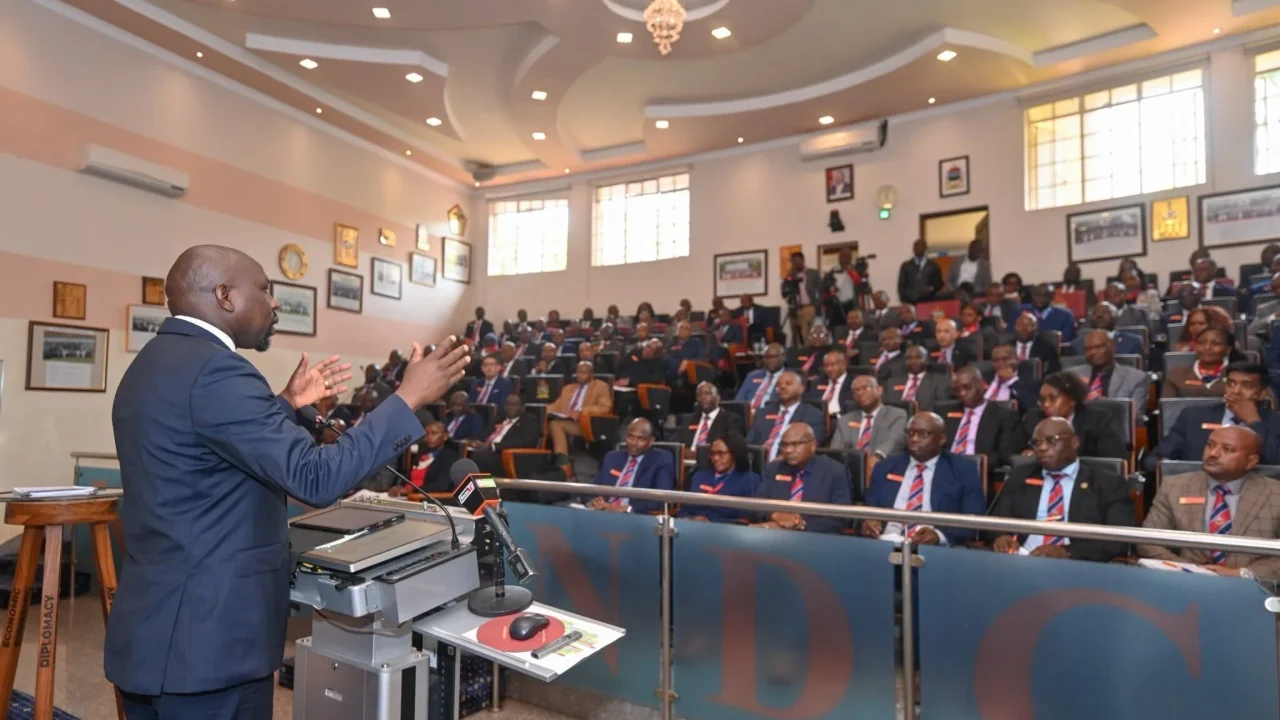
Interior Cabinet Secretary Kipchumba Murkomen called for stronger citizen participation in security during a lecture at the National Defence College in Nairobi.
The Interior CS wants citizen reports analysed together to flag emerging threats, with agencies tracking concerns, taking action and reporting back to communities.
Interior and National Administration Cabinet Secretary Kipchumba Murkomen has called for a stronger framework to turn information from communities into strategic intelligence, helping security agencies detect threats and act before they escalate.
Speaking at the National Defence College in Nairobi during a lecture on citizen participation as a strategic pillar of national security, Murkomen said public involvement could play a central role in Kenya’s security strategy.
He urged the Government to establish mechanisms for analysing reports from different communities together, rather than treating each concern as an isolated issue. Such an approach, he said, would help agencies recognise recurring patterns and use them to anticipate risks and inform policy.
Turning local reports into early warnings
Murkomen illustrated the value of collective analysis by describing how similar reports from ten communities could point to a broader pattern. Viewed together, those accounts could provide strategic intelligence that helps the Government prepare for emerging security challenges.
He said Kenya’s approach should extend beyond conventional community policing and support an ongoing exchange of information between the public and security agencies.
The emphasis would be on connecting information held locally with formal security structures. Community reports would therefore contribute not only to identifying immediate concerns, but also to assessing wider risks when similar issues emerge in different areas.
Murkomen cited Rwanda’s experience with citizen participation in strategic intelligence as an example from which Kenya could learn.
A structured role for Jukwaa La Usalama
The Cabinet Secretary identified Jukwaa La Usalama as a platform that could make public participation a lasting part of security governance.
He said the Government was committed to institutionalising the platform, giving Kenyans a structured channel through which to raise security concerns and contribute to decisions affecting them.
Under the approach he outlined, engagement would not end when a public meeting closes. Instead, the platform would support a continuing relationship in which citizens identify problems, agencies coordinate responses and communities receive feedback on the results.
Measuring action rather than meetings
Murkomen said the success of Jukwaa La Usalama should be judged by the response to concerns raised, rather than simply by how many meetings take place.
He said the Government would continue refining the model to link identified problems to multi-agency action and report back on what had changed.
This would place greater emphasis on following up community concerns, tracking the steps taken by government agencies and assessing whether interventions deliver measurable improvements.
Murkomen’s proposed framework centres on closing the gap between what communities know and what security institutions can act upon. He said stronger citizen engagement could reinforce public participation in national security while making the exchange of information more consistent and useful.