


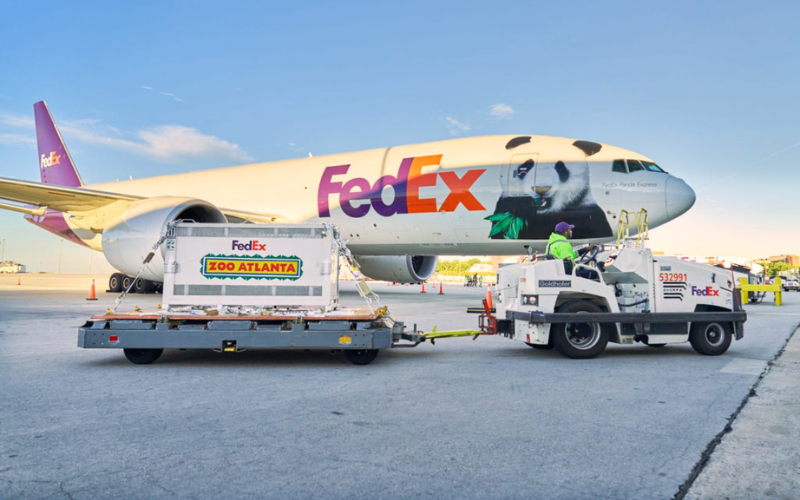
Ping Ping and Fu Shuang are Zoo Atlanta’s new giant pandas under a 10-year conservation agreement with China.
Ping Ping and Fu Shuang travelled aboard the FedEx Panda Express and will spend a month in quarantine before visitors can see them.
Two giant pandas from China arrived at Zoo Atlanta on September 27 under a new 10-year loan agreement, renewing a conservation partnership between the American zoo and China.
Ping Ping, a six-year-old male, and Fu Shuang, a five-year-old female, made the 8,000-mile journey from the Chengdu Research Base of Giant Panda Breeding. Their arrival brings Zoo Atlanta back into the small group of United States facilities housing the species.
The exchange comes against a backdrop of tensions between Washington and Beijing over trade and artificial intelligence. Despite those differences, the two countries recently agreed during a state visit to extend a pause in their trade dispute.
A specially prepared journey
Preparations for the pandas’ transfer began well before their departure from China. Both animals completed a month-long quarantine and underwent training intended to help them tolerate loud sounds and the containers used to transport them.
They then boarded a dedicated cargo aircraft known as the FedEx Panda Express. Supplies on the flight included fresh bamboo, water and treats for the long journey to the United States.
After landing at Hartsfield-Jackson Atlanta International Airport, the pandas were taken directly to Zoo Atlanta with a police escort.
Visitors will not be able to see the pair immediately. Zoo officials said Ping Ping and Fu Shuang would spend a standard one-month quarantine period in a secure facility within the zoo.
A new decade of conservation cooperation
The pandas’ arrival follows the signing of a fresh 10-year loan agreement earlier this year. Zoo Atlanta had previously returned its panda family to China when a 25-year agreement came to an end.
With the new pair in residence, Zoo Atlanta is now one of three facilities in the United States keeping giant pandas, following the animals’ recent return to San Diego and Washington, D.C.
Under the standard arrangements governing giant panda loans, host institutions pay around $1 million, equivalent to Sh129.69 million, each year to support wildlife conservation in China. Cubs born while their parents are on loan remain Chinese property.
Breeding hopes for Ping Ping and Fu Shuang
Wildlife experts chose the two pandas on the basis of their health and genetic diversity. Conservationists hope the pair will develop a bond naturally and eventually breed.
There has been progress in protecting giant pandas in the wild. Their population has recovered to about 1,900, while the species’ conservation classification has improved from endangered to vulnerable.
Breeding in captivity, however, remains challenging. Female giant pandas are fertile for only a few days each year, leaving a narrow opportunity for successful reproduction. That biological constraint remains an important consideration in the hopes surrounding Ping Ping and Fu Shuang’s new home.