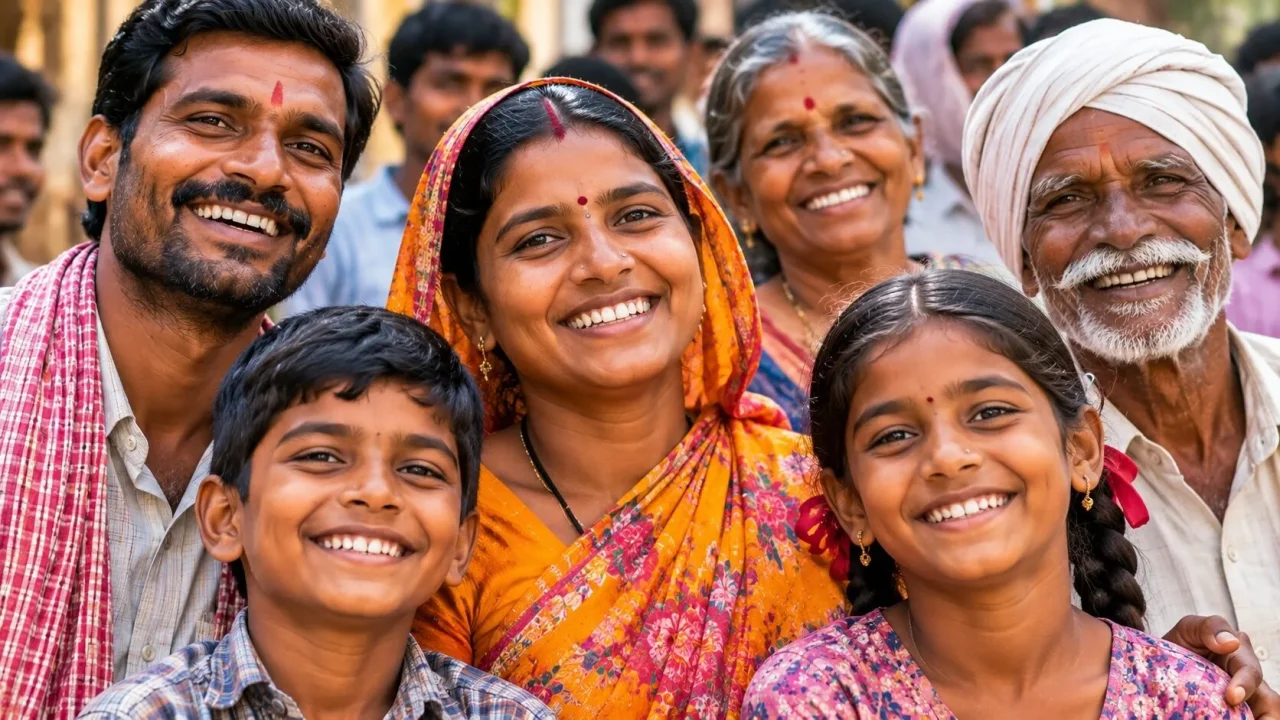
India has recorded substantial declines in rural and urban poverty.
World Bank figures show sharp declines in rural and urban hardship, although millions still face poverty and financial insecurity.
Poverty in India has fallen sharply, with nearly 496 million people crossing the World Bank’s lower-middle-income poverty threshold. The change covers the period from 2011–12 to 2023–24.
A World Bank assessment puts the share living below $4.20 a day at 16.1 per cent in 2023–24. That compares with 57.7 per cent in 2011–12.
Meanwhile, extreme poverty also declined substantially over the same period. The proportion living on less than $3 daily dropped from 27.1 per cent to 2.6 per cent.

Both rural and urban communities recorded gains. Rural extreme poverty fell from 31 per cent to 3.1 per cent, while the urban rate decreased from 17.4 per cent to 1.4 per cent.
What helped reduce poverty in India
Expanded banking access, welfare programmes and public infrastructure investment have helped strengthen household economic security. These initiatives include the Pradhan Mantri Jan Dhan Yojana banking programme and Aadhaar-linked direct benefit transfers.
Subsidised food distribution has also supported vulnerable families. In particular, free food grains have helped protect households against hunger and economic shocks.
Alongside these measures, rural electrification, sanitation facilities and better digital connectivity have widened access to essential services. India’s growing economy has also provided resources for infrastructure, public services and social protection.
The progress reflects reforms, agricultural improvements, expanding markets and welfare initiatives across successive governments. Prime Minister Narendra Modi’s administration has accelerated welfare delivery and digital public infrastructure development. However, the longer decline also draws on policies introduced under earlier administrations.
Millions still face financial insecurity
Despite the gains, the World Bank estimates that about 35 million people in India remain in extreme poverty. Around 232 million still live below the broader $4.20-a-day threshold.
Crossing a poverty line does not necessarily give a household lasting financial security. Families can still face insecure employment, inadequate housing, rising healthcare costs and limited access to quality education.
As a result, illness or a sudden loss of income can push households back into hardship. Protecting the gains therefore remains important alongside efforts to reach people still living in poverty.
Longer-term priorities include stronger manufacturing, productive employment, improved education and affordable healthcare. Greater participation by women and young people, alongside investment in skills and social protection, can also support more secure livelihoods.