Western Sahara remains on the UN decolonisation agenda following the Fourth Committee’s decision.
Morocco joins countries supporting the annual resolution, while the US and Israel oppose it as negotiations over the territory’s future continue.
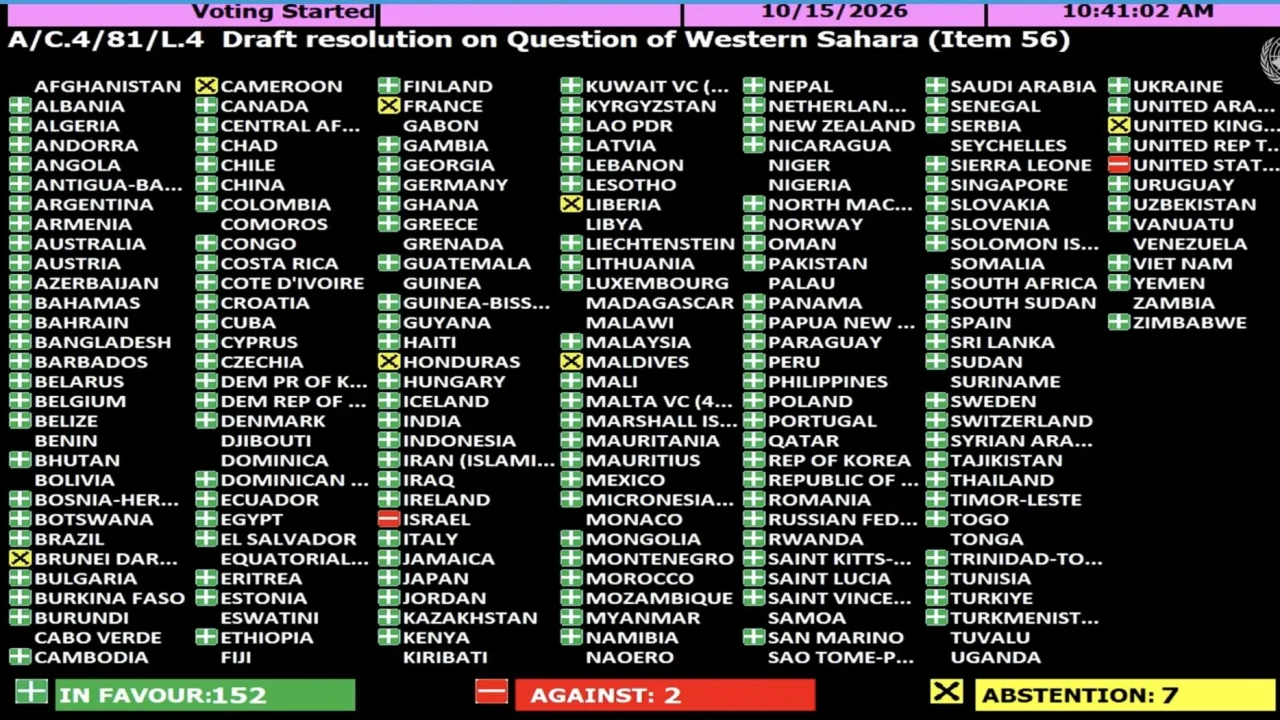
The Western Sahara vote at the United Nations General Assembly’s Fourth Committee drew support from 152 countries on Thursday. The annual resolution reaffirmed the territory’s place on the UN decolonisation agenda.
Morocco voted in favour, while the United States and Israel opposed the text. Seven countries abstained in a recorded ballot that departed from the committee’s usual practice.
The decision maintains the UN’s treatment of Western Sahara as a Non-Self-Governing Territory. However, it does not settle the dispute or determine the territory’s final political status.

Why the Western Sahara vote took place
The committee normally adopts the annual resolution without a vote. This time, however, the US delegation requested recorded votes on all 23 draft resolutions before the committee.
That request also covered texts the committee would ordinarily approve without a ballot. It therefore prompted a recorded vote on the Western Sahara resolution.
The committee adopted the text under its agenda on implementing the Declaration on the Granting of Independence to Colonial Countries and Peoples. Meanwhile, diplomatic efforts continue to seek a mutually acceptable political settlement.
Negotiations over the territory’s future
Western Sahara has remained disputed since Spain withdrew in 1975. Morocco controls most of the territory, while the Frente Polisario challenges Moroccan sovereignty and seeks Sahrawi self-determination.
The UN supports settlement efforts through its political process and the United Nations Mission for the Referendum in Western Sahara, known as MINURSO.
In his latest report, the UN Secretary-General outlined the Security Council’s call for a just, lasting and mutually acceptable solution. That solution should also provide for the self-determination of Western Sahara’s people.
Security Council Resolution 2797, adopted in October 2025, called for negotiations using Morocco’s autonomy proposal as a basis. At the same time, it retained the objective of a mutually acceptable settlement providing for self-determination.
In 2026, the Secretary-General’s Personal Envoy, Staffan de Mistura, helped restart direct negotiations. Morocco, the Frente Polisario, Algeria and Mauritania took part.
The parties held three rounds of talks in Washington and Madrid during January and February. Despite that engagement, the Secretary-General’s report said low-intensity hostilities continued in the territory.
Refugee funding remains limited
The report also highlighted humanitarian needs among Sahrawi refugees. The 2026–2027 Sahrawi Refugee Response Plan requires US$179 million.
However, funding secured for 2026 stood at only US$15 million as of June 30. The report said the shortfall constrained essential services.
The Fourth Committee’s resolution keeps Western Sahara within the General Assembly’s continuing decolonisation work. Meanwhile, the UN has urged the parties to pursue negotiations and avoid actions that could undermine a peaceful settlement.