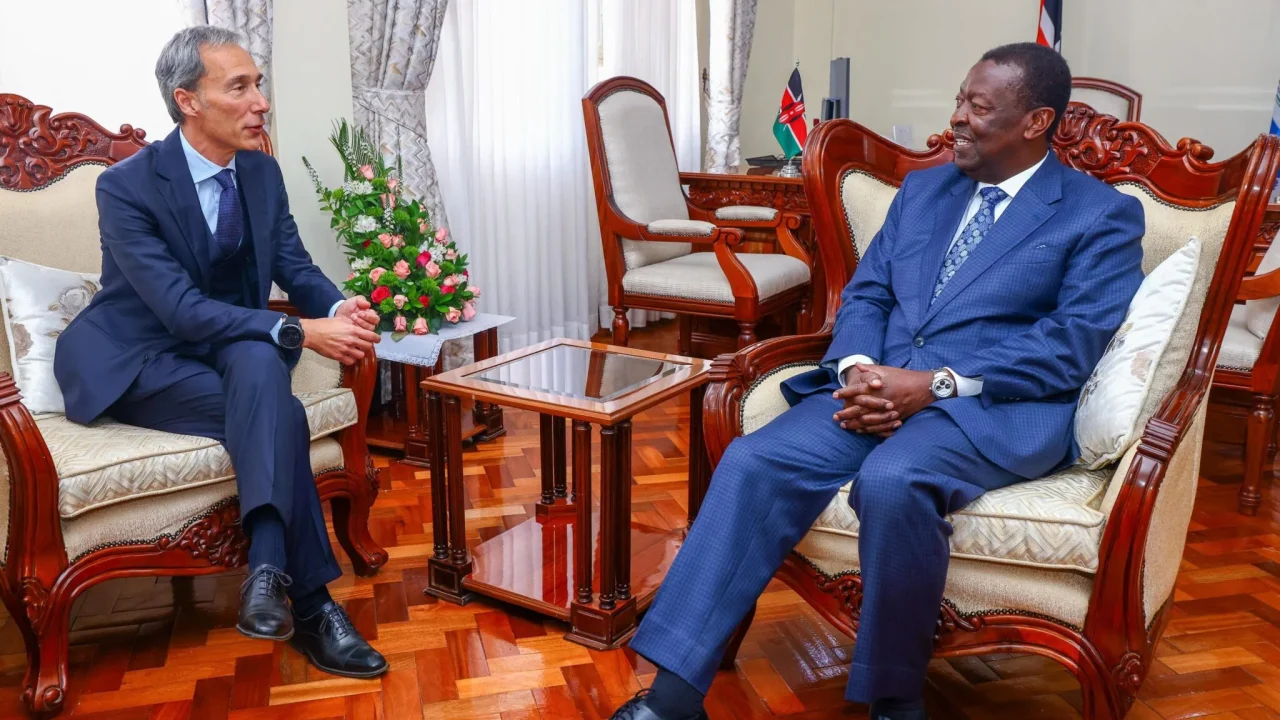
Musalia Mudavadi received the credentials of new IFAD Kenya representative Matteo Marchisio.
Musalia Mudavadi and new IFAD country director Matteo Marchisio outlined priorities for stronger harvests, rural incomes and youth opportunities in agribusiness.
The Kenya IFAD partnership aims to raise farm productivity, strengthen climate resilience and expand rural employment. Prime Cabinet Secretary Musalia Mudavadi outlined these priorities while receiving new country director Matteo Marchisio’s credentials on Thursday.
Mudavadi, who also serves as Foreign Affairs Cabinet Secretary, highlighted smallholder productivity and stronger rural incomes. The discussions also covered food security and agriculture’s role in Kenya’s economic growth.
He said the cooperation would target better harvests, higher earnings and more opportunities for young people in agribusiness. His broader goal is to make farming more profitable and strengthen its contribution to the economy.

Kenya IFAD partnership focuses on rural livelihoods
Marchisio formally took up his role as IFAD Country Director and Representative to Kenya on October 15. His arrival comes as Kenya and the International Fund for Agricultural Development approach five decades of cooperation.
He reaffirmed IFAD’s commitment to rural livelihoods, food security and communities’ ability to withstand climate shocks. Marchisio also stressed the importance of shared responsibility and commitment in the partnership.
Rural communities face growing climate risks alongside pressure to improve agricultural output. Meanwhile, Kenya’s growing youth population offers opportunities to expand agribusiness and employment.
IFAD supports smallholder farmers, rural businesses and financial services in Kenya. Its work also seeks to improve market access and strengthen the activities connecting agricultural production to buyers.
In addition, the organisation promotes sustainable management of natural resources as part of its rural development work. These areas form part of the broader effort to improve livelihoods and economic opportunities.
Preparing communities for climate shocks
IFAD is also working with the government to improve preparedness for climate-related shocks. This includes strengthening early warning systems, reducing risks to vulnerable households and protecting productive assets.
Its El Niño preparedness and response work includes identifying measures that could help rural communities recover faster. Alongside recovery, that work aims to build communities’ resilience over the longer term.
New country strategy planned for 2027
Preparation of IFAD’s new Kenya country strategy in 2027 will help shape the next phase of cooperation. The strategy is expected to align future investments with government priorities and long-term development goals.
The process will involve national and county governments, farmers’ organisations, businesses and development partners. It will therefore bring several groups into discussions on future support.
Marchisio also acknowledged Kenya’s role in IFAD’s governance and thanked the government for its Fourteenth Replenishment pledge. He described the pledge as evidence of Kenya’s commitment to multilateral cooperation and sustainable rural development.
Kenya joined IFAD in 1977. Since then, the fund has financed more than 20 programmes and projects and mobilised nearly US$1.4 billion in the country.
Those investments have supported agricultural development, rural livelihoods and climate resilience, while also expanding economic opportunities for rural communities.