Matteo Marchisio has assumed office as IFAD’s Country Director and Representative to Kenya.
The new country director will lead cooperation on rural livelihoods, climate resilience and agricultural productivity as IFAD prepares Kenya’s next country strategy.
Matteo Marchisio has taken office as the International Fund for Agricultural Development’s Country Director and Representative to Kenya. His tenure begins as IFAD prepares to develop its next country strategy for Kenya in 2027.
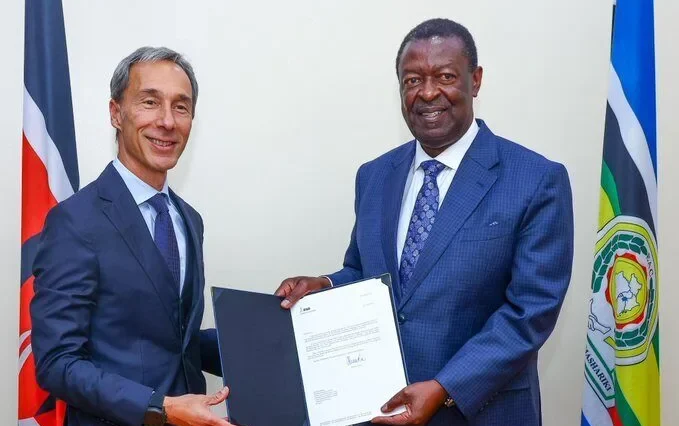
He formally assumed the role on Thursday after presenting his credentials to Musalia Mudavadi. Mudavadi serves as Prime Cabinet Secretary and Cabinet Secretary for Foreign Affairs.
The appointment opens a new chapter in a partnership spanning nearly five decades. Priorities include climate-resilient farming, higher smallholder productivity, agribusiness growth and wider economic opportunities in rural communities.

Matteo Marchisio outlines rural development priorities
Marchisio reaffirmed IFAD’s commitment to Kenya’s development priorities, particularly rural livelihoods, food security and climate resilience. He also stressed the importance of shared responsibility and commitment in sustaining the partnership.
Meanwhile, Mudavadi expressed the government’s interest in closer cooperation to make agriculture more productive and profitable. He emphasised better livelihoods for farmers and young people, linking farmer empowerment to national food security.
Their discussions also covered agricultural productivity, resilience to climate change and higher rural incomes. These areas form part of the incoming director’s priorities for cooperation with Kenya.
New country strategy due in 2027
A central task for Marchisio will be preparing IFAD’s next Kenya country strategy in 2027. The process will offer an opportunity to align future investments with government priorities and emerging rural challenges.
National and county governments will take part alongside private-sector representatives, farmers’ organisations and development partners. Together, they will help shape the next phase of cooperation.
The strategy will build on existing investments while identifying further opportunities to improve productivity and rural livelihoods. It will also explore ways to expand economic opportunities within Kenya’s rural economy.
Nearly five decades of agricultural cooperation
Kenya joined IFAD in 1977, and the partners are now approaching 50 years of cooperation. Since then, IFAD has financed more than 20 programmes and projects.
The organisation has also mobilised nearly US$1.4 billion for rural transformation, agricultural development and climate resilience. Its current programmes support smallholder farmers, rural enterprises and financial services.
In addition, those programmes help strengthen agricultural value chains, access to markets and sustainable management of natural resources. IFAD is working with the government to improve preparedness for climate-related shocks.
That work includes early warning systems, measures to reduce risks and support for vulnerable rural households. Marchisio also acknowledged Kenya’s role in IFAD’s governance and welcomed its pledge to the organisation’s Fourteenth Replenishment. The replenishment supports IFAD’s development work.