

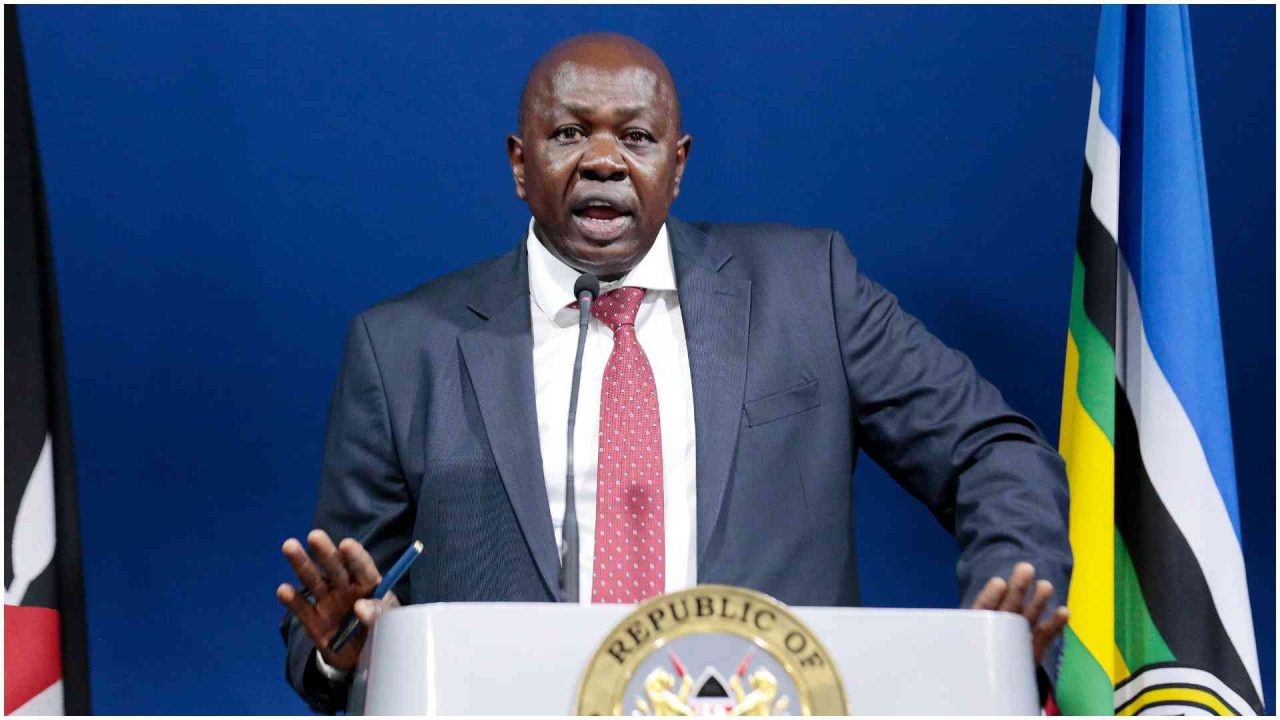
Government Spokesperson Charles Owino addresses the media on September 7, 2026.
Owino says the uniform change affects general-duty Kenya Police officers, while welfare, accountability and oversight remain central to broader reforms.
Government Spokesperson Charles Owino has defended the change of uniform for general-duty Kenya Police officers, saying it is one part of a broader reform programme rather than a substitute for better welfare and accountability.
Responding to criticism that the government had prioritised appearance over deeper institutional problems, Owino said progress should be assessed through improvements in policing and the service’s relationship with the public, not simply the colour of officers’ clothing.
He said reforms involve several processes moving at different speeds, including policy development, legislation, training and administrative changes that may be less visible than a new uniform.
Uniform change limited to general-duty officers
Owino clarified that the change applies to general-duty Kenya Police officers, including those commonly deployed at stations and on patrol. The Administration Police Service and General Service Unit uniforms remain unchanged.
He said the decision followed recommendations relating to officers’ appearance, the practicality of their clothing and working conditions. The previous blue uniform, he explained, became dirty easily, faded and lost its intended appearance over time.
While acknowledging the public’s right to question government priorities, Owino argued that a visible change should not be taken as evidence that other reforms have stalled. He said uniforms can support identification and practicality, but cannot on their own deliver institutional transformation.
Welfare needs extend beyond clothing
Owino said housing, healthcare, pay, training and working conditions must remain central to police reform, particularly given the security risks and difficult environments in which officers serve.
He pointed to efforts involving housing and remuneration, alongside continuing discussions on other welfare concerns. However, he said implementation depends on public resources, policy decisions and time.
On maternity wear, Owino said pregnant officers need comfortable clothing suited to their duties. He added that designs should be open to review if officers identify practical shortcomings, with feedback and public participation informing any adjustments.
He also acknowledged that maternity clothing cannot be considered separately from wider support for female officers. Leave arrangements, healthcare, suitable facilities and working environments should form part of a comprehensive approach to their welfare.
Removing pockets cannot end bribery
Owino rejected the suggestion that removing pockets from traffic police uniforms would, by itself, prevent corruption. Drawing on his experience as a criminal investigator, he said people seeking to conceal money could use other locations or pass it through intermediaries.
He argued that tackling bribery requires stronger systems, effective supervision and transparent procedures rather than relying on clothing design.
Body-worn cameras and appropriate surveillance systems could help document encounters between officers and the public, he said. Officers who accept bribes should also face disciplinary or legal action, while corruption should not be regarded as a problem confined to the police service.
Maraga proposals require implementation steps
Addressing concerns about delays in implementing the Maraga Task Force recommendations, Owino said the report did not automatically put its proposals into effect. Recommendations must be considered, developed into policy and, where necessary, taken through the legislative process.
He said the Interior Ministry had established a steering committee to prepare an implementation framework. Proposed legislation or measures being processed include provisions on public order management and strengthening the Independent Policing Oversight Authority’s oversight role, he added.
Owino also described police reform as a longstanding process, noting that officers had previously raised proposals for a police service commission, civilian oversight and closer institutional integration.
He said laws and oversight bodies provide a framework, but meaningful change depends on training, supervision, resources and consistent accountability. Officers who break the law must answer for their conduct, he added, while individual wrongdoing should not automatically be attributed to the entire service.