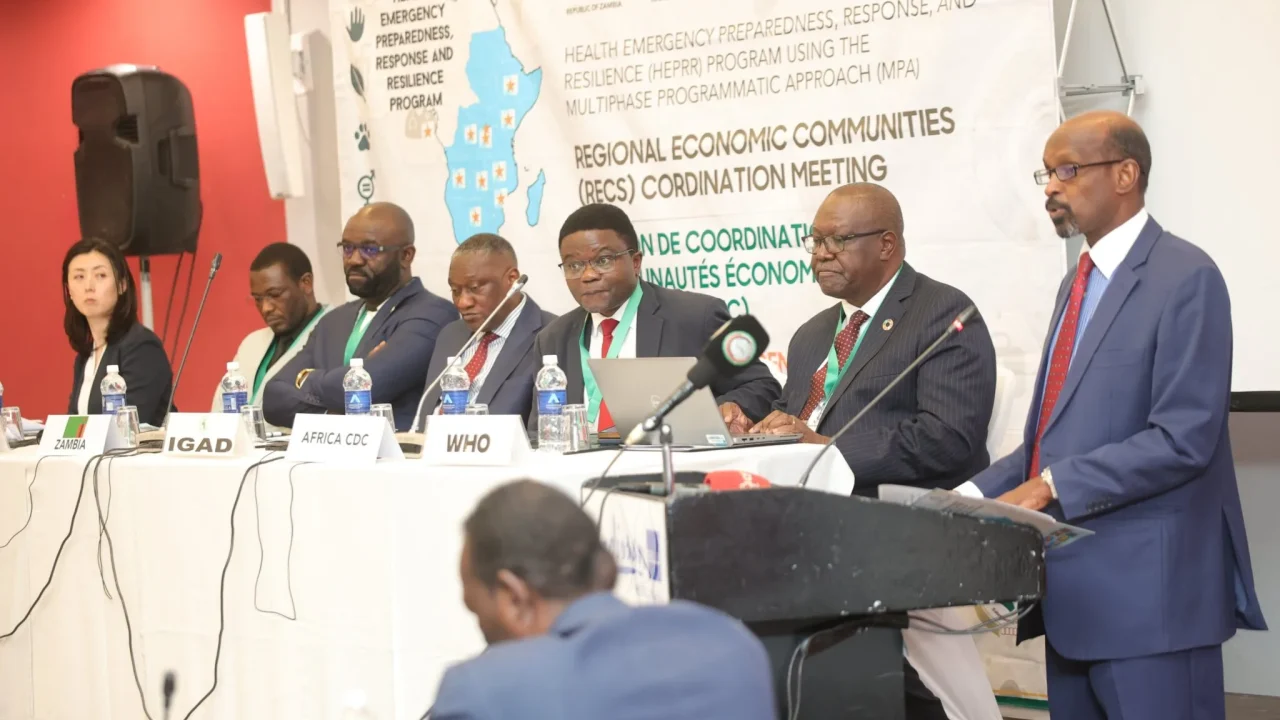
Five regional blocs met in Lusaka to advance cooperation on health emergency preparedness.
Five regional blocs propose pooled purchasing, coordinated manufacturing and stronger border surveillance to improve Africa’s response to health emergencies.
Five African regional economic blocs have called for joint health financing and coordinated procurement of medical supplies. The proposals aim to strengthen emergency preparedness and support local production of essential health products.
The blocs adopted the recommendations during an October 14–16 meeting in Lusaka, Zambia. They also sought sustained investment in health security beyond current project funding.
Participants included the Intergovernmental Authority on Development (IGAD), Southern African Development Community (SADC) and Common Market for Eastern and Southern Africa (COMESA). The East African Community (EAC) and Economic Community of Central African States (ECCAS) also took part, alongside health partners.

Joint health financing and pooled purchasing
The recommendations propose a regional financing compact to sustain health emergency preparedness, response and resilience. The blocs seek support from the United Nations Economic Commission for Africa and the World Health Organization (WHO).
Under the proposals, regional communities would prepare joint funding requests and coordinate engagement with potential funders. These include technical and development partners, philanthropists and private investors supporting agreed manufacturing priorities.
The blocs also recommended pooled procurement, including purchasing arrangements between regional communities. Joint demand forecasts and long-term purchasing agreements would help create more predictable markets for locally manufactured products.
Through these measures, the blocs aim to address shortages of essential supplies during public health emergencies. They also want African manufacturers to build capacity to meet regional demand.
Building on existing manufacturing capacity
However, the blocs cautioned countries against duplicating manufacturing facilities and investments that may not be commercially viable. Instead, they urged governments to build on existing capacity across the regional communities.
The approach would involve sharing technical expertise, training institutions, centres of excellence and regional reference laboratories. A joint action framework would also set responsibilities, timelines, resource commitments and performance indicators.
Alongside this, the recommendations seek closer coordination between African Union health agencies, WHO and regional communities. Their work would align manufacturing priorities with medicines regulation and pandemic preparedness.
The African Medicines Agency and regional blocs would strengthen regulatory cooperation and support national regulatory authorities. They would also encourage authorities to draw on assessments from other recognised regulators.
Meanwhile, Africa CDC and the blocs would identify priority medical products for public health emergencies. Coordinated procurement would strengthen purchasing power while giving local manufacturers greater certainty about demand.
Stronger surveillance across borders
Beyond manufacturing, the blocs proposed coordinated investment at priority border entry points and formal cross-border agreements. These measures would improve outbreak detection and management.
Countries would harmonise operating procedures, share information and strengthen referral systems and joint planning. The recommendations also propose expanded field epidemiology training, simulation exercises and professional exchanges.
Regional laboratory networks would improve diagnostic capacity, align quality standards and strengthen cross-border sample referrals. Faster sharing of surveillance data would further support coordinated responses.
In addition, the blocs called for a One Health approach linking human, animal and environmental health. Joint risk assessments and early-warning systems would support that work.
A shared learning agenda would also address technology transfer, intellectual property, manufacturing standards, financing and workforce development.
Programme includes Kenya
IGAD convened the meeting with the East, Central and Southern Africa Health Community. It took place under the Health Emergency Preparedness, Response and Resilience Programme for Eastern and Southern Africa.
The programme became effective in March 2024 and is scheduled to run until March 2030. It covers Kenya, Angola, Botswana, Burundi, the Democratic Republic of the Congo, Ethiopia, Malawi, Mozambique, Rwanda, São Tomé and Príncipe, and Zambia.