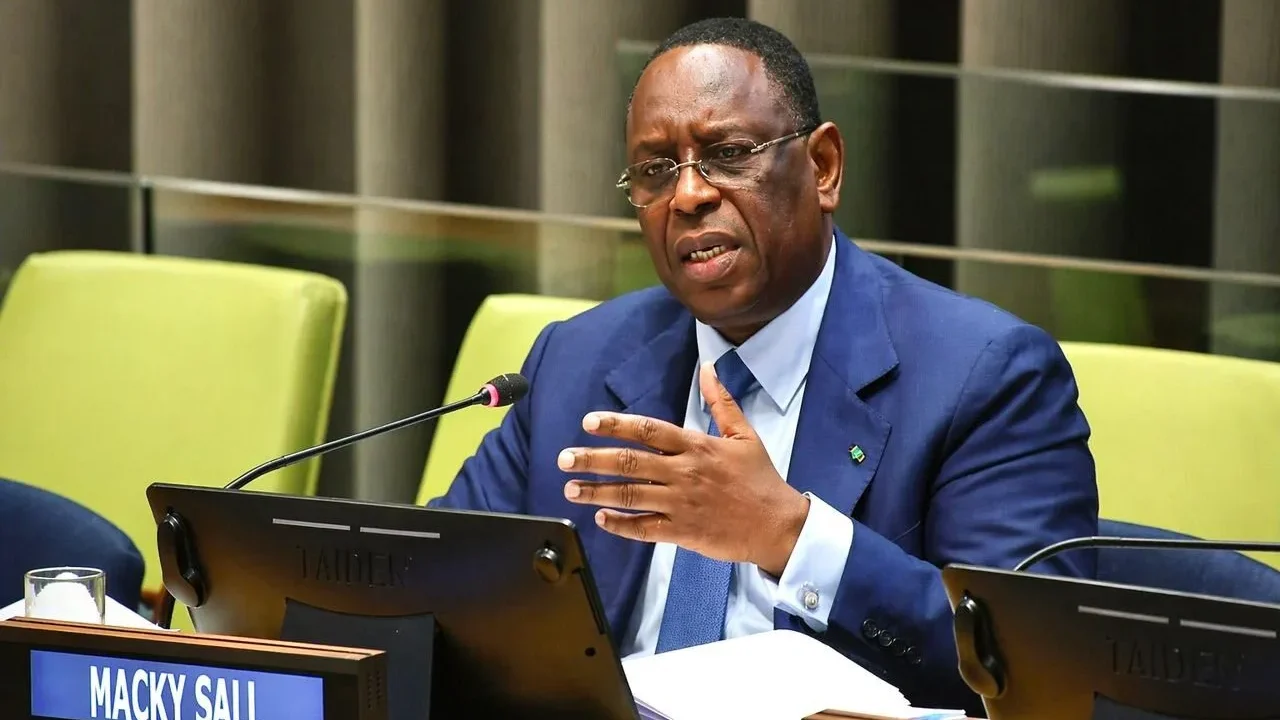
Former Senegalese President Macky Sall has ended his bid to lead the United Nations.
The former Senegalese president says his exit could help the Security Council agree on a successor to António Guterres.
Former Senegalese President Macky Sall withdraws from the UN Secretary-General race, hoping to help secure a consensus candidate. He announced his decision on Saturday after the Security Council’s sixth informal straw poll on October 16.
All seven candidates received at least one “discourage” vote from a permanent Council member in that ballot. However, those votes do not constitute formal vetoes at this stage.
In his statement, Sall said a sense of responsibility guided his decision to leave the contest. He hoped his withdrawal would help Council members agree on a successor to António Guterres.

Macky Sall withdraws after consultations
Sall said he consulted Burundi President Evariste Ndayishimiye, the African Union chairperson, before reaching his decision. He also consulted Senegal President Bassirou Diomaye Diakhar Faye, who chairs the Economic Community of West African States.
He thanked Ndayishimiye for sponsoring his candidacy and Faye for supporting it. Sall also acknowledged Council members who backed him and the team that ran his campaign.
The former president said he had sought to bring nearly four decades of public service experience to the UN. However, he said successive straw polls suggested a preference for someone from Latin America and the Caribbean, possibly a woman.
Security Council poll reveals divisions
The October 16 vote marked the first round using coloured ballots for the five permanent members. This distinguished their choices from those of the Council’s 10 elected members.
The permanent members are China, France, Russia, the United Kingdom and the United States. Each can block a candidate when the Council makes its formal recommendation.
Results circulating after the confidential ballot showed Costa Rica’s Rebeca Grynspan received the most “encourage” votes. However, she also received five “discourage” votes, including two from permanent members.
Meanwhile, circulating results gave Uganda’s Olara Otunnu four “encourage” votes, 10 “discourage” votes and one “no opinion” vote.
The other contenders included Guyana’s former foreign minister Carolyn Rodrigues-Birkett and Argentina’s Rafael Grossi. Ecuador’s Ivonne A-Baki and María Fernanda Espinosa were also in the seven-person field alongside Sall, Grynspan and Otunnu.
UN appointment process and reform calls
Although the straw polls indicate Council members’ preferences, they remain informal and non-binding. Members can therefore change their positions before a formal recommendation.
At that stage, a candidate needs at least nine affirmative votes and no opposition from any permanent member. The General Assembly then makes the appointment on the Security Council’s recommendation.
The next Secretary-General will take office after Guterres completes his second five-year term on December 31, 2026.
Despite ending his campaign, Sall reaffirmed his commitment to peace, security, development, international cooperation and dialogue. He also urged the UN to overhaul its working methods and operations.
Sall argued that conflicts, geopolitical rivalries and economic pressures made such changes necessary. He further called for Africa to pursue greater influence in global governance, citing its role in peace, security and development debates.