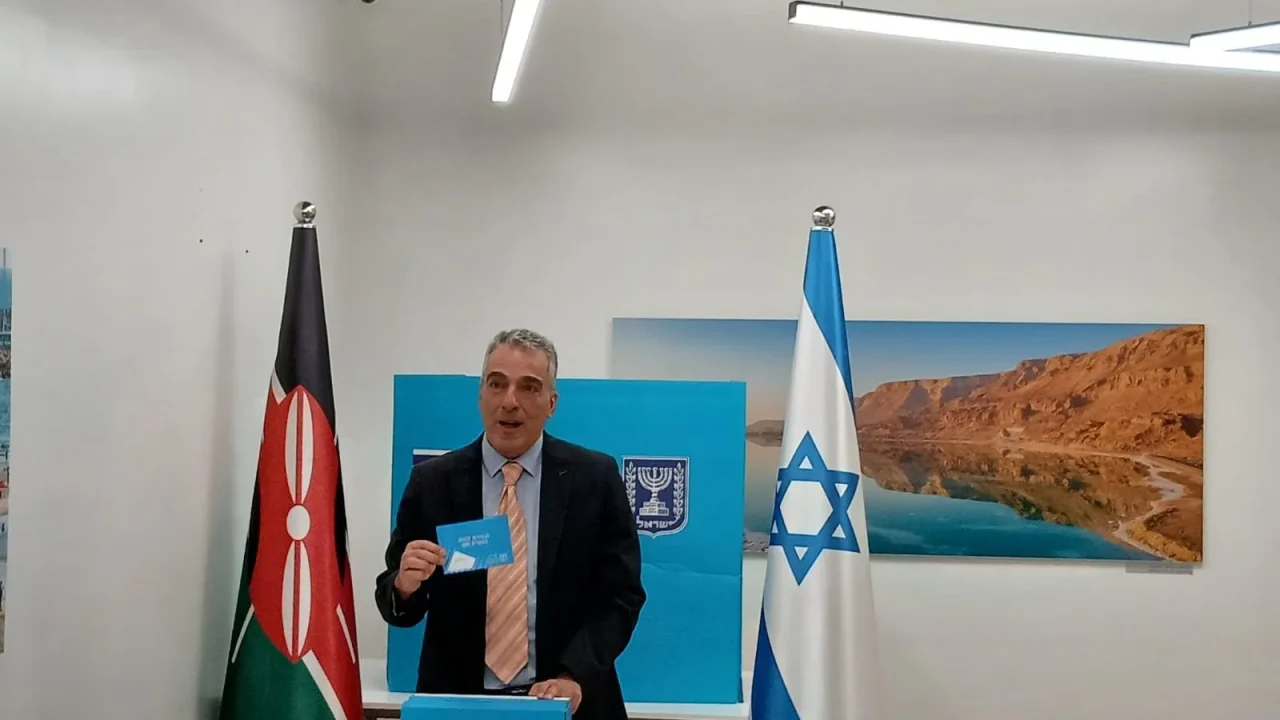
Israeli diplomats cast early ballots at the embassy in Nairobi ahead of the October 27 election.
Ambassador Gideon Behar says officials will send the sealed ballots to Israel for counting alongside votes cast in the national parliamentary election.
Israeli diplomats vote in Nairobi ahead of the October 27 parliamentary election, joining eligible officials at diplomatic missions worldwide. The diplomats cast their ballots at the Israeli Embassy on Thursday.
Ambassador Gideon Behar said the exercise allows citizens on official assignments abroad to participate in Israel’s democratic process. The election will determine the membership of the 120-seat Knesset, which shapes the formation of the next government.
Israeli diplomats vote ahead of national poll
Behar said officials would seal the Nairobi ballots and fly them to Israel through diplomatic channels. The Central Elections Committee will receive them for inclusion in the national tally.

Counting officials will open those ballots alongside votes cast in Israel, he explained. However, the overseas arrangement covers only eligible officials on foreign assignments and qualifying family members.
It does not extend a general overseas voting option to all Israeli citizens living abroad.
Behar expressed pride in taking part from Nairobi. He also stressed that his position as ambassador gave his ballot no greater weight than any other eligible voter’s.
Voters to choose the 26th Knesset
According to Behar, about 7.3 million people qualify to vote in a population of approximately 10 million. He said citizens aged 18 and above could participate regardless of religion, gender or minority background.
The ambassador also said 38 parties were competing, offering voters a range of political choices. The October 27 election will choose members of the 26th Knesset.
Unlike Kenya’s presidential system, Israelis vote for political party lists rather than directly choosing a prime minister. Qualifying parties receive a share of the Knesset’s 120 seats in proportion to their votes.
After the results, parties negotiate a coalition capable of forming a government. The prime minister therefore emerges through the parliamentary process, not a separate nationwide presidential ballot.
The Knesset passes laws, scrutinises government activities and represents voters. Elections normally take place every four years, although certain circumstances can trigger an earlier poll.
Security, economy and ties with Kenya
Meanwhile, Behar identified security, citizens’ welfare and the economy as key concerns likely to influence voters. The election comes amid security challenges, regional conflicts and economic concerns facing Israel.
He expressed confidence in the electorate’s judgement and said he would accept the result. In his view, the outcome would reflect voters’ wishes.
Beyond the election, Behar described Kenya as an important partner with longstanding ties to Israel. He highlighted cooperation in agriculture, education, health, security and water management.
The ambassador also said thousands of Kenyans had travelled to Israel for training over the years. Both countries, he added, were seeking closer relations through further cooperation and tourism.
The Nairobi embassy’s regional responsibilities extend to Uganda, Tanzania, Malawi and Seychelles. It also covers United Nations organisations in the region and the East African Community.