


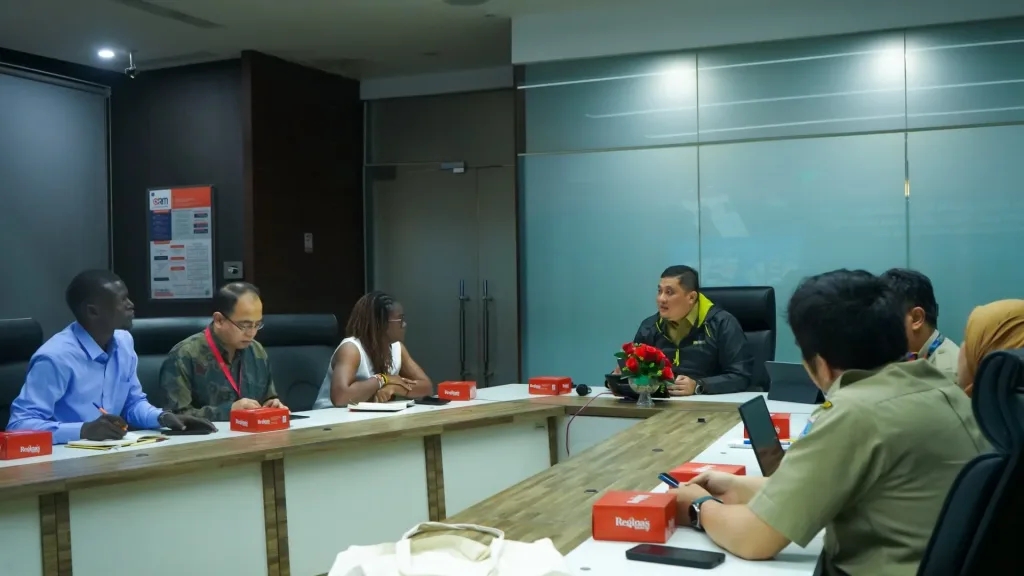
Jakarta links resident complaints, transport data and government action, offering Nairobi lessons on coordination rather than simply acquiring more technology.
Jakarta’s use of digital complaints, traffic monitoring and integrated public transport offers Nairobi a practical lesson: urban technology needs to connect information with agencies capable of acting on it.
During a familiarisation visit by Kenyan journalists, Jakarta Smart City head Ponirin Ariadi outlined how the Indonesian capital brings together reports from residents, government information, CCTV feeds and sensors to guide service delivery.
For Nairobi, where congestion, uncollected waste, damaged roads and disorderly motorcycle movement remain familiar challenges, the approach raises a question beyond whether another application is needed: can existing systems assign responsibility and show residents whether a problem has been resolved?
Turning resident reports into action
Jakarta’s JAKI application allows residents to photograph a problem, submit details and follow the response through a unique report number. Complaints enter a backend system that can classify them, identify duplicates and direct them to the relevant government unit or field team.
Residents can follow a case through its handling stages, while officials can upload photographs showing completed work. Jakarta officials said some problems could be addressed in about 14 hours, but that was not presented as a standard turnaround for every complaint.
Ariadi said citizen participation helps the administration understand residents’ concerns. He also described efforts to bring departments together rather than leave information isolated within separate offices.
Artificial intelligence is being introduced into parts of the reporting and verification process, including analysis of photographs submitted as evidence of completed work. Officials nevertheless acknowledged risks from manipulated images and deepfakes, alongside the difficulty of keeping pace with rapid changes in AI.
Kenya’s eCitizen platform already provides access to government services. Jakarta’s approach highlights a complementary role for digital systems: enabling residents to supply information that feeds directly into everyday city operations.
Connecting traffic data and public transport
Jakarta’s CCTV network has expanded beyond security. Ariadi said cooperation with the private sector began in 2015, when the city received about 500 cameras at no cost. He outlined a target of roughly 30,000 cameras within two to three years.
Camera capabilities include counting vehicles and people, generating information that can support traffic analysis and alternative routing. For Nairobi, which is moving towards an Intelligent Transport System covering monitoring, automated enforcement and traffic management, the lesson is to link that information to the agencies making operational decisions.
Jakarta has also sought to connect transport services. TransJakarta is linked with the MRT and LRT, while traditional services such as Kopaja have been reorganised under JakLingko. Payment integration is part of the effort to make transfers between different transport modes easier.
Nairobi has commuter rail, buses, matatus and boda bodas, but journeys can involve difficult transfers and separate payments. Digital information alone cannot resolve those gaps: coordinated routes, functioning interchanges and cooperation between operators are also necessary.
Waste collection still needs workers and equipment
Waste management demonstrates where technology’s role ends and physical delivery begins. Jakarta has invested in a Refuse-Derived Fuel facility in Cilincing and is seeking additional processing capacity, while encouraging household waste separation and public participation.
A digital report can identify a garbage pile and direct a response, but collection still depends on workers, equipment, funding and an institution able to deploy them.
JAKI also carries air-pollution information gathered through city sensors and details of infrastructure projects. That allows residents to receive information about government activity, including roadworks that could disrupt travel, as well as submit their own concerns.
Nairobi’s challenge is joining existing systems
Nairobi already has channels for reporting service problems and digital systems for services including water and sewerage. Its challenge is therefore not starting from scratch, but making those tools work together.
Jakarta officials described their model as the result of years of technology and transport investment, supported by changes in local-government financing and regulation that strengthened infrastructure investment capacity.
The two cities have different institutions, infrastructure and transport networks, limiting any direct transfer of Jakarta’s model. Its central lesson remains relevant, however: collecting information is only useful when responsibility is clear, action follows and residents can check the outcome.