Raila Odinga addresses journalists outside IEBC offices during the 2017 election technology dispute.
A year after Raila’s death, divisions over his pact with William Ruto sharpen debate about compromise, constitutional reform and opposition accountability.
The Raila Odinga legacy faces competing interpretations a year after his death on October 15, 2025. His allies and former supporters remain divided over whether cooperation with President William Ruto can deliver lasting reform.
The disagreement centres on Raila’s final political pact, but it also reflects a longer pattern. Throughout his career, he moved between confrontation and negotiation, helping secure constitutional gains while electoral mistrust persisted.
Raila Odinga legacy in constitutional reform
Raila helped drive the campaign for multiparty democracy alongside activists, religious leaders and ordinary citizens. His mass mobilisation also kept electoral competition and constitutional change central to national debate.

Political analyst Professor Adams Oloo, a Raila ally leading preparations for his first-anniversary commemoration, praised his willingness to sacrifice personal ambition. Similarly, House Minority Leader Junet Mohamed highlighted Raila’s ability to balance resistance with reconciliation at his burial in Bondo.
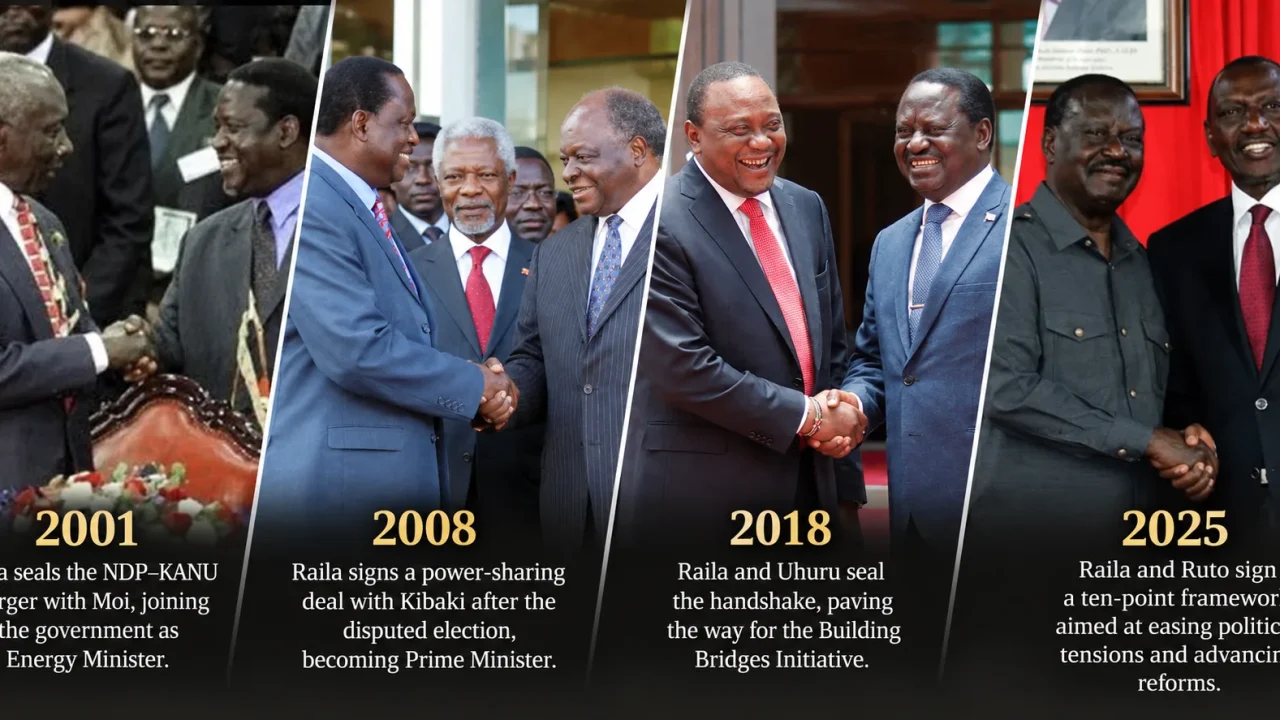
However, Raila’s alliances repeatedly changed the course of his opposition politics. After his first presidential bid in 1997, he aligned his National Development Party with KANU in 2001.
He joined President Daniel arap Moi’s government as energy minister before returning to the opposition ahead of the 2002 election. That election ended KANU’s long rule.
In 2005, Raila helped defeat President Mwai Kibaki’s proposed constitution. The Orange campaign subsequently helped consolidate the movement that developed into the Orange Democratic Movement.
The disputed 2007 presidential election then plunged Kenya into violence. Historical accounts of the crisis put the toll at 1,133 deaths and roughly 600,000 displaced people.
International mediation produced a power-sharing agreement that brought Raila into government as Prime Minister in 2008. Although it helped end the immediate crisis, disputes over electoral credibility remained.
Raila and Kibaki later helped secure agreement on the proposed system of government. Together, they led the Grand Coalition Government’s successful campaign for the 2010 Constitution.
The Constitution expanded rights, introduced devolution and strengthened checks on executive power. Those changes emerged from a collective reform effort in which Raila played a prominent role.
Electoral disputes and the handshake
The Supreme Court annulled the August 2017 presidential election, demonstrating the judiciary’s power to challenge electoral outcomes. However, the ruling did not settle the political distrust surrounding the contest.
Raila’s National Super Alliance demanded credible results transmission and accountability from electoral officials it accused of bias. He then boycotted the repeat election and took an unofficial presidential oath on January 30, 2018.
In March, Raila reconciled with President Uhuru Kenyatta through the handshake. Their agreement eased confrontation and produced the Building Bridges Initiative, which proposed constitutional changes addressing governance and inclusion.
However, the initiative failed in court, underlining the limits of political agreement without constitutional compliance. Raila subsequently lost the 2022 presidential election to Ruto, and the Supreme Court upheld the result.
Ruto partnership divides ODM
Raila led protests against Ruto’s administration in 2023 over living costs, taxation and electoral concerns. By contrast, the 2024 Gen Z-led Finance Bill protests challenged both government leaders and established opposition figures.
Many young demonstrators demanded accountability over economic hardship, corruption and state violence without deferring to traditional political leadership. Meanwhile, Ruto backed Raila’s African Union Commission chairmanship campaign, which Kenya launched in August 2024.
Raila lost the continental election to Djibouti’s Mahmoud Ali Youssouf in February 2025. The following month, he signed a ten-point cooperation framework with Ruto.
The agreement covered devolution, electoral reform, corruption, peaceful assembly and constitutionalism. However, its implementation became a dividing line within ODM.
Edwin Sifuna’s Linda Mwananchi faction accused Ruto’s United Democratic Alliance of failing to honour its commitments. After Sifuna’s removal as ODM secretary-general, the faction left and adopted The Equitable Party, with plans to rename it.
Meanwhile, the Oburu Oginga-led Linda Ground camp took control of ODM and supported continued cooperation as a reform strategy. The breakaway group argues that engagement without results risks weakening opposition scrutiny.
That dispute now places Raila’s final agreement alongside the constitutional achievements his supporters celebrate. It also leaves his political movement confronting unresolved questions about electoral trust, accountability and the value of negotiated reform.