

Donald Trump presented Xi Jinping with a bald eagle sculpture during a state dinner in Washington.
The US president said he helped design the gift, presented at a Washington state dinner during a summit aimed at strengthening ties with China.
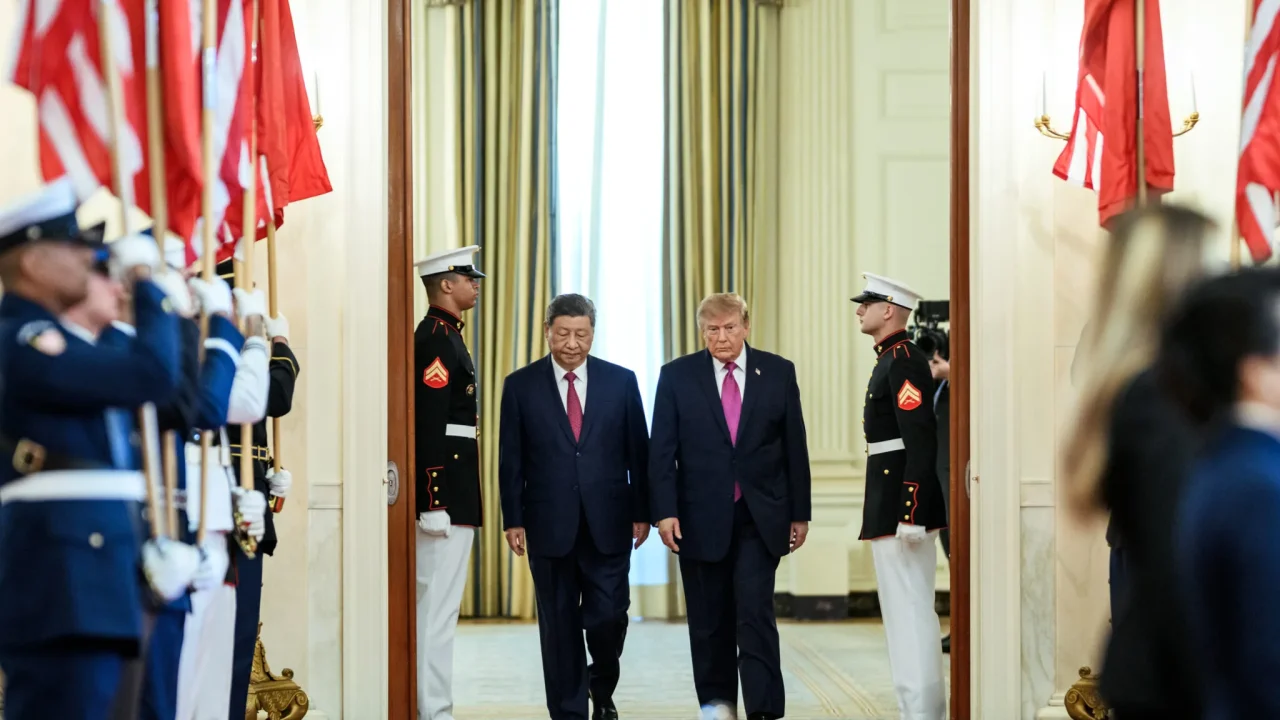
US President Donald Trump presented Chinese President Xi Jinping with a bald eagle sculpture at a state dinner in Washington, using America’s national symbol as a diplomatic gift during their three-day summit.
Unveiled before guests at Thursday’s dinner, the sculpture represented America’s spirit of freedom, Trump said. He added that he and First Lady Melania Trump had taken part in designing it.
The presentation formed part of a wider effort to build personal ties between the two leaders as their countries navigate trade tensions and competition in artificial intelligence.
A symbolic gesture with diplomatic weight
The bald eagle is native to North America, giving the sculpture a distinctly American identity. Its presentation also illustrated the role that carefully chosen gifts can play in relations between governments.
Daniel Kritenbrink, a partner at The Asia Group who spent more than 30 years as a US diplomat, largely in Asia, said personal relationships remain important even when leaders face complicated policy disagreements.
He described the direct relationship between Trump and Xi as an important stabilising element in an exceptionally complex bilateral relationship. Both leaders, he said, place value on diplomacy conducted at the highest level, with gift exchanges contributing to that personal connection.
Gifts have also been a prominent feature of Trump’s presidency. Items he has received include a luxury jumbo jet, an engraved gold bar and a gold ring decorated with diamonds and other jewels.
Ole Jacob Sending of the Norwegian Institute of International Affairs said gift-giving, understood broadly, is closely associated with Trump’s approach to political relationships.
Xi announces pandas and student exchanges
Earlier on Thursday, Xi announced that China would send two pandas to Zoo Atlanta and introduce a programme to welcome 100,000 American students to study in China over five years.
Xi described giant pandas as symbols of friendship between the Chinese and American people. He said the animals, named Ping Ping and Fu Shuang, would arrive at their new home within days.
It was not clear whether the Chinese president had presented any additional gifts.
The announcements placed cultural and educational exchanges alongside the formal summit discussions, offering another avenue for building connections between the two countries.
Gift exchanges require careful planning
Diplomatic gifts are rarely casual purchases. Sending said officials spend weeks negotiating details, including what should be presented, where the exchange should take place and how it should be conducted.
Morten Skumsrud Anderson, who co-authored a study on diplomacy and gifts with Sending, said lavish exchanges remain more common in Gulf states and autocratic governments. Western democracies, by contrast, operate under tighter restrictions and oversight.
In the United States, foreign government gifts valued above the current $525 limit generally become federal property unless the president pays to retain them personally.
Past exchanges show how gifts can either reinforce a diplomatic message or create awkwardness. Barack Obama gave Xi an inscribed redwood bench linked to California, where the two leaders had met. They later sat on it together for photographs.
Another exchange proved less successful. British Prime Minister Gordon Brown gave Obama an ornamental pen holder made from the timber of a historic anti-slavery ship, while Obama presented DVDs reportedly incompatible with British players.
Trade truce provides the backdrop
The Washington summit marked Trump and Xi’s third face-to-face meeting since the start of Trump’s second term. It took place against a backdrop of intense competition in artificial intelligence and a bitter trade dispute eased by a temporary truce, which was extended during the trip.
For Kritenbrink, the ceremonial elements of the visit served a practical purpose: supporting a more stable US-China relationship. The gifts, performances and formal hospitality were tools for that larger goal, rather than ends in themselves.