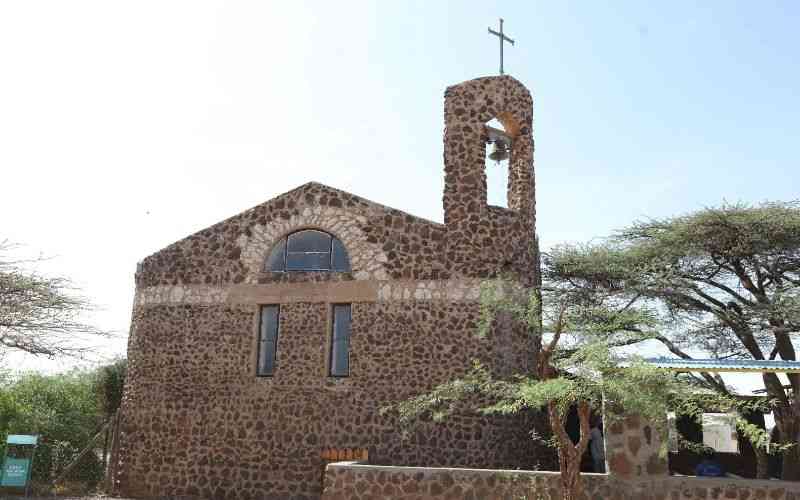
Kalacha Catholic Church in Marsabit County houses biblical murals created in 1984.
Murals by Ethiopian artist Alemdyehu Bizuneh draw visitors to a desert church that continues to serve a growing congregation.
Kalacha Catholic Church in Marsabit County combines biblical murals, unusual architecture and a history stretching back to 1972. Located between Maikona and North Horr in the Chalbi Desert, it attracts travellers alongside its worshippers.
Known locally as the Church of the Spring Water, the church features paintings from both biblical testaments. Ethiopian artist Alemdyehu Bizuneh created the works in August 1984, two years after the church opened.
Catechist Martin Molu says Kenyan and foreign visitors stop to pray, learn about the church or take photographs. Meanwhile, the congregation continues to grow, prompting construction of a larger worship space.

Biblical art at Kalacha Catholic Church
The murals depict the baptism of Jesus, the calling of his first disciples and the Last Supper. They also portray his crucifixion, with the image of Christ on the cross standing out among the paintings.
Old Testament scenes occupy the church’s left side, while other sections illustrate Jesus’ ministry and Christian saints. Further depictions include Jesus washing his disciples’ feet, Zacchaeus the tax collector and Saint Anthony the Abbot.
Beyond their decorative role, the paintings have helped generations of worshippers engage with biblical teachings. For visitors, they also offer religious art away from Kenya’s more familiar tourism routes.
The building’s design adds another distinctive feature, with sections set into the ground around volcanic rock formations. Inside, the altar and pulpit occupy the central worship space, while the murals form their backdrop.
From a small mission to a growing congregation
Catholic missionaries established their first station in Kalacha in 1972, beginning with a small Christian community. Molu says an Italian missionary known locally as Father James erected the first iron-sheet building.
At the time, the congregation numbered about 10 believers. As membership increased, the community needed a permanent place of worship, and the present church opened in 1982.
The original structure later served as a dispensary before becoming a nursery school. It therefore continued supporting the community after worship moved into the newer building.
Today, the church adds a cultural and religious stop to journeys through Marsabit County. The wider region also includes the Chalbi Desert, Lake Turkana’s shores and communities with deeply rooted cultural traditions.
However, worship remains the church’s main purpose despite its appeal to travellers. Molu says the growing congregation needs more room, and the larger building will provide additional space for worshippers.