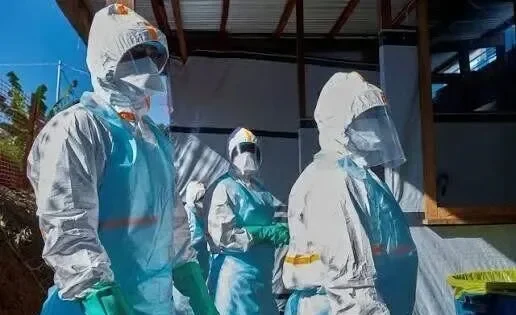
Health Cabinet Secretary Aden Duale says Kenya must meet WHO conditions to end the Ebola outbreak.
Health authorities continue testing contacts as Duale says Kenya must meet WHO requirements before formally ending the outbreak.
Kenya could secure Ebola-free status after 42 consecutive days without new infections, Health Cabinet Secretary Aden Duale said. However, authorities must also meet World Health Organization requirements before formally ending the outbreak.
Speaking on Citizen TV’s Sunday Live programme, Duale said teams had traced all identified contacts. Health officials were also conducting regular tests and preparing to clear contacts who had completed monitoring.
He said the last positive case was recorded on October 19. Nearly 551 people underwent testing in the preceding 48 hours, he added, with all samples returning negative results.

WHO conditions for Ebola-free status
However, a short period without positive tests does not mean the outbreak has ended. WHO guidance ties the 42-day countdown to the last confirmed patient testing negative twice and leaving care, or other specified circumstances.
Kenya is responding to Bundibugyo virus disease, a form of Ebola. The initial patient had travelled from the Democratic Republic of Congo through Uganda before arriving in Nairobi.
The patient died on October 5, and laboratory confirmation followed the next day. Subsequent infections involved contacts, including relatives and healthcare workers.
As of October 20, WHO reported nine confirmed cases in Kenya, including one death. The eight subsequent cases had links to the initial patient, with no evidence of wider community transmission at that time.
Contacts await final clearance
Meanwhile, Duale said contacts completing the mandatory 21-day monitoring period were undergoing final tests and clinical assessments. Ebola’s incubation period ranges from two to 21 days, making monitoring essential after exposure.
Contacts who remain symptom-free still need negative test results and clinical clearance before returning home. The Director General would oversee the clinical assessment and required protocols, Duale said.
He also reported a 100 per cent contact-tracing rate, above the 85 per cent benchmark he cited. Detected infections had links to known contacts rather than unidentified community transmission, he maintained.
Counties strengthen outbreak preparedness
Duale said more than 26 high-risk counties had protective equipment and other response supplies. He also cited 21 isolation intensive care beds, 4,900 trained healthcare workers and 342 deployed first responders.
Additionally, Kenya had five laboratory facilities, including two mobile laboratories, to support testing for patients in isolation. Clinician and nurse representatives had also joined the multi-sectoral response task force, he said.
The government urged the public to maintain hygiene precautions and avoid contact with patients’ blood and other body fluids. It also advised immediate medical attention for symptoms including fever, weakness, vomiting, diarrhoea and unexplained bleeding.