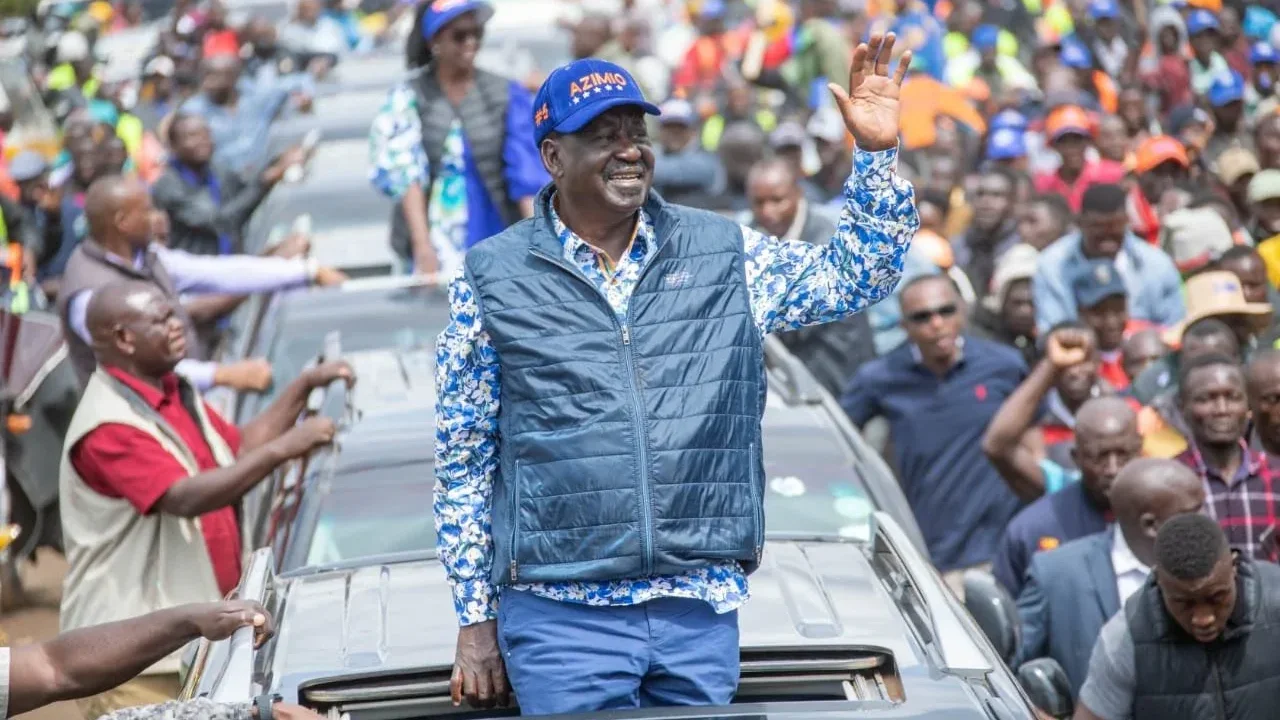
Oburu Oginga leads ODM as the party prepares for the 2027 election.
ODM leaders favour cooperation with Ruto, while opposition figures invoke Raila Odinga’s reform legacy to court his supporters.
The Raila succession contest is exposing competing political visions as leaders seek his supporters ahead of the 2027 General Election. A year after his death, neither ODM nor the wider opposition has settled on a common direction.
President William Ruto and ODM’s leadership emphasise cooperation, development and continued influence in government. Meanwhile, opposition figures invoke the former prime minister’s record of democratic reform and demands for accountability.
The divide reflects two strands of Raila’s career: challenging governments and negotiating with political rivals. However, association with his name offers no guarantee of inheriting his electoral support.

Raila succession puts ODM’s alliance under scrutiny
Ruto’s case for cooperation rests partly on the ten-point framework he signed with Raila in March 2025. It covered governance reforms, devolution, youth employment, public debt, corruption and civil liberties.
During a September 13 church service in Kisumu, Ruto acknowledged the difficulty of replacing Raila. He argued that national development could help sustain the late leader’s legacy.
Meanwhile, an August announcement said UDA and ODM had agreed to develop a joint manifesto and contest the 2027 election together. The partnership could help Ruto reach Raila’s former voters while preserving ODM’s role in national decision-making.
However, it also raises questions about ODM’s identity after decades of challenging successive administrations. Party leader Oburu Oginga and national chairperson Gladys Wanga have stressed the importance of retaining political influence.
At an October 9 memorial event in Kakamega, Wanga also pledged fair and transparent party nominations. Senate Minority Leader Stewart Madzayo said ODM had struggled after Raila’s death but was gradually finding stability.
Madzayo said the party would not field a presidential candidate in 2027, but intended to do so in 2032.
Sifuna and Orengo push an opposition alternative
Nairobi Senator Edwin Sifuna, the former ODM secretary general, has challenged the direction taken by the party leadership. Instead, he presents democratic freedoms, accountability and the rule of law as central to Raila’s legacy.
On October 4, Sifuna unveiled The Equitable Party as his political vehicle, with plans to rename it the Linda Mwananchi Movement. The formation seeks to offer an alternative to ODM’s current course.
A July TIFA survey found that 74 per cent of ODM supporters identified with the Linda Mwananchi faction. By comparison, 20 per cent identified with the Linda Ground faction associated with the party leadership.
However, those findings did not establish general-election voting intentions or demonstrate that factional support would translate into votes for Sifuna. Oburu also retains an established party organisation, elected representatives and grassroots networks.
Siaya Governor James Orengo has meanwhile aligned himself with emerging opposition formations and expressed interest in the presidency. Embakasi East MP Babu Owino has also invoked Raila’s legacy through a slogan presenting himself as Baba’s successor.
Kalonzo courts supporters as family legacy draws attention
Wiper leader Kalonzo Musyoka bases his appeal on a long political partnership with Raila. He served as Raila’s running mate in the 2013 and 2017 presidential elections.
During a May visit to Homa Bay, Kalonzo said he had supported Raila for 15 years. He asked residents to back his own presidential bid in return.
His outreach has also taken him to Bondo, where he invoked democracy, justice and the rule of law. Meanwhile, he has led efforts to rebrand the Azimio coalition as the Ukombozi Alliance for the opposition campaign.
However, opposition leaders still face disagreements over coalition structures and the presidential candidate selection process. Separate appeals to Raila’s former supporters could therefore split the constituency they hope to bring together.
The succession debate also extends to the Odinga family. During anniversary-related activities in Bondo, a section of Luo elders symbolically crowned EALA MP Winnie Odinga as her father’s political heir.
That gesture highlights the family name’s enduring significance, but it does not establish an electoral mandate. Raila built his authority through decades of organising, reform campaigns, alliances and relationships beyond his home region.
Ultimately, the 2027 election will test whether ODM can maintain its influence without its defining leader. It will also test whether rival claimants can turn appeals to his legacy into durable organisations and voter support.