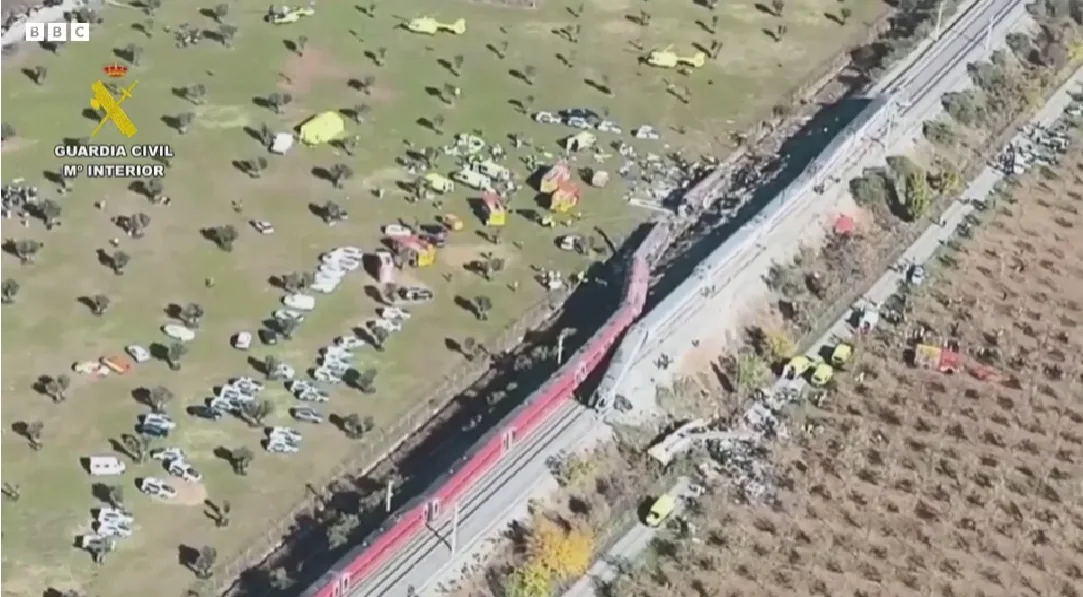
Emergency teams worked overnight to search for victims and clear debris after the collision.
Emergency crews search wrecked carriages as officials investigate why a train hit a stationary service on the Madrid–Seville route.
Spain has begun three days of mourning after a Spain train crash killed at least 68 people. Dozens more suffered injuries when a Madrid–Seville service struck a stationary train on Wednesday morning.
Emergency crews worked overnight under powerful floodlights, cutting through damaged carriages to search for victims. Meanwhile, many of those who died still await identification as officials investigate the collision.
Prime Minister Pedro Sánchez said the country was grieving and described the immense pain facing bereaved families. He also said the disaster had shattered lives and torn families apart.

Spain train crash recovery continues
Spain’s interior ministry said hundreds of personnel had deployed to the site to support recovery efforts. Teams also used drones and helicopters as they searched for victims and removed rubble.
Private rail operator Iryo said another train struck its stationary service from behind. Its train carried 147 passengers, while the other service, operated by state-owned Renfe, carried 397.
The impact sent several carriages down an embankment. Witnesses described passengers crying and bleeding, with some trapped in their seats.
Smoke also spread through the carriages, and one caught fire. Emergency teams continued searching the wreckage and clearing debris through the night.
Investigators examine train control decisions
Transport Minister Óscar Puente said a computer failure had forced the Iryo train to stop on the tracks. He explained that a round-the-clock control centre in Madrid takes over when a system fails.
However, Puente said the centre then instructed the trains to move again without speed restrictions. He described that decision as inexplicable.
Audio recordings between Madrid controllers and train drivers appear to show clearance for one high-speed train to proceed. Another train ahead had stalled, raising questions about the instructions preceding the collision.
Officials continue to investigate the cause of the disaster.
Parties suspend election campaigns
Sánchez also criticised Spain’s second serious rail disaster this year, calling the situation unacceptable. A high-speed crash near Córdoba killed 46 people in January on the same line, but much further south.
Following Wednesday’s collision, most political parties suspended campaigning for upcoming elections. However, the far-right Vox party chose to continue.
Its leader, Santiago Abascal, said his party would not join what he characterised as efforts to silence criticism. He argued that mourning should not prevent scrutiny of the country’s rail infrastructure.