


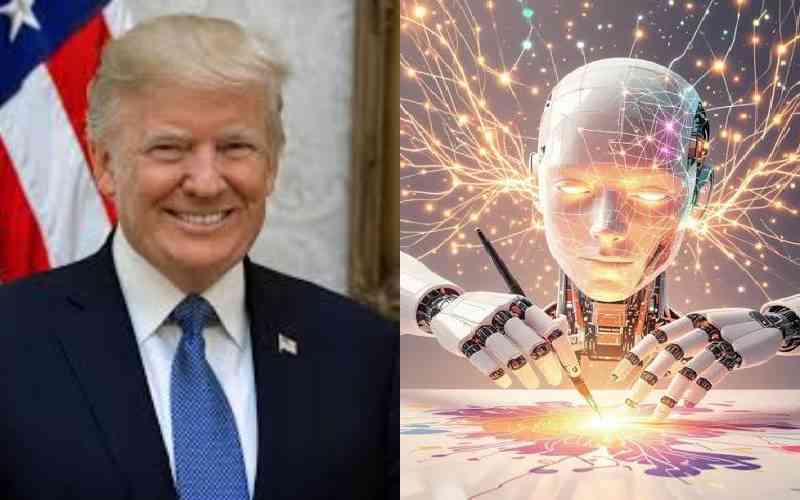
Donald Trump’s proposed AI terminology change accompanies his opposition to international oversight of the technology. (Photo: tnx.africa)
The US president says the new wording better reflects AI’s capabilities, but the source report gives no confirmed timetable for federal agencies to adopt it.
US President Donald Trump has announced plans to replace the term artificial intelligence with “super intelligence” in official US government documents, according to a TNX Africa report citing the BBC.
The report says Trump outlined the proposed terminology during a September 22 address to the United Nations General Assembly in New York. He also used the speech to oppose international regulation of the technology, arguing that the United States should prioritise rapid development.
However, the announcement was not accompanied by a confirmed executive order or a detailed implementation timetable, according to the source report. It therefore remains unclear when federal agencies would be required to change their wording.
Why Trump wants a new name
Trump’s argument centred on the impression created by the word artificial. He said it could make the technology sound fake or diminish its significance, while the proposed replacement would better capture the expanding capabilities of modern systems.
Under his proposal, the abbreviation AI would give way to SI. The president also expressed hope that other countries would adopt the same terminology rather than retain the name currently used across research, business and public policy.
TNX Africa reported that the choice followed polls Trump conducted on X and Truth Social. The preferred label reportedly finished ahead of alternatives including superior intelligence, extreme intelligence and supreme intelligence.
Opposition to global AI oversight
The naming announcement formed part of a broader message against international controls on the sector. Citing The Washington Post, the report said Trump portrayed proposed global supervision as a globalist initiative that could hinder US technological progress.
He argued that the industry should be allowed to expand quickly to help the United States maintain an advantage over competitors, particularly China. Rather than endorse new international regulatory institutions, he said his administration would use the Justice Department to monitor the sector where intervention was needed.
That position comes amid continuing debate among governments, researchers and technology companies over appropriate safeguards. Concerns outlined in the report include misinformation, employment disruption, privacy risks, cybercrime and the difficulty of controlling more advanced systems.
A political label, not a scientific change
The proposed wording also carries a distinction that could complicate its use. In AI research, superintelligence refers to a theoretical system whose abilities would substantially exceed those of humans across almost every intellectual task, from scientific work to communication and problem-solving.
Today’s chatbots, image generators and workplace tools are not generally considered to meet that definition. Strong performance on particular tasks does not establish that a system is more capable than people across all areas of reasoning.
The source report characterises the proposal as an administrative and political change rather than a scientific breakthrough. Renaming the technology would not alter how existing systems operate or automatically revise the rules governing AI companies. Whether the label gains acceptance beyond US government messaging remains uncertain.