

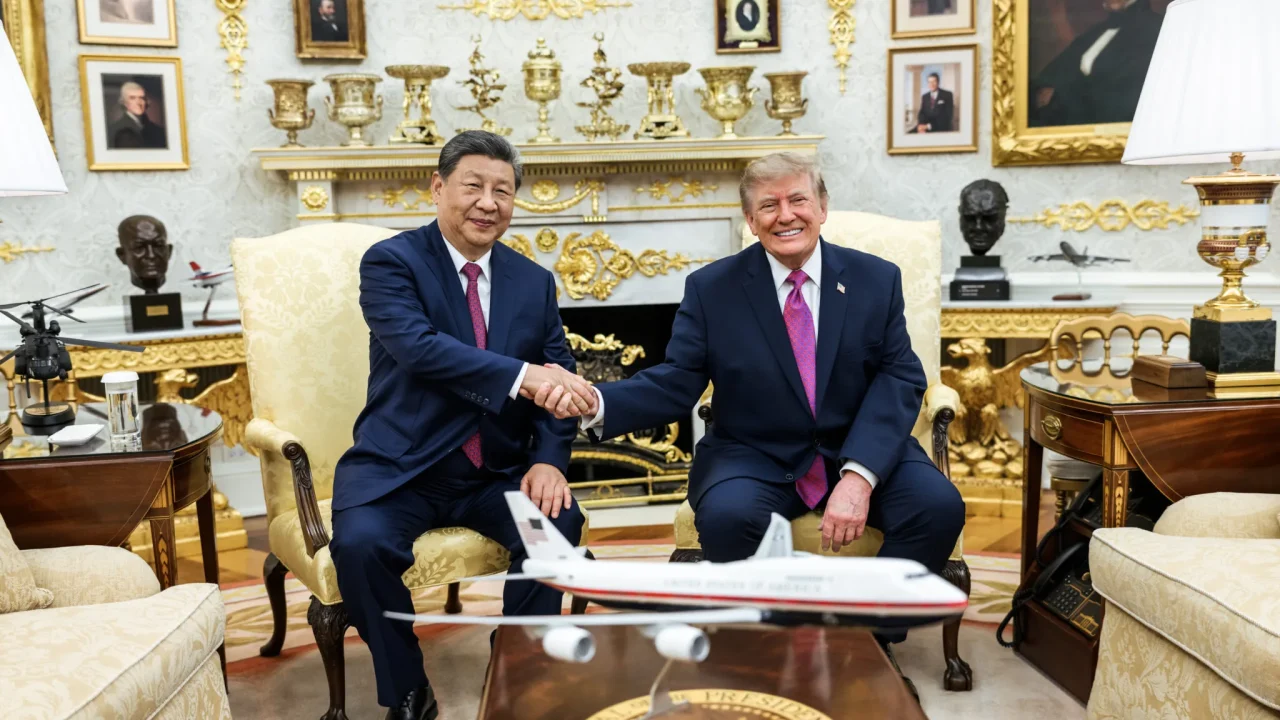
Donald Trump and Xi Jinping attend a White House dinner during the Chinese leader’s Washington visit.
A lavish Washington welcome for Xi Jinping delivered a short trade reprieve, while disputes over tariffs, Taiwan and advanced technology remained unsettled.
US President Donald Trump and Chinese President Xi Jinping extended their countries’ trade truce during talks in Washington, but the limited reprieve left major disagreements over tariffs, technology and Taiwan unresolved.
The pause in their retaliatory tariff dispute was extended from November to January, falling short of Beijing’s hopes for an agreement lasting at least a year. The extension avoided another immediate escalation without settling the issues driving tensions between the two powers.
Xi received an elaborate welcome, including a personal airport greeting and a White House state banquet. Yet the diplomatic ceremony produced fewer substantive gains for Beijing, which wants Washington to ease pressure on China’s trade and technological ambitions.
Short truce leaves trade questions open
The limited extension pushes disputes over tariffs, China’s dominance in rare earth supplies and access to advanced US chips into another round of negotiations. A longer agreement would have offered Beijing greater certainty as it seeks to preserve access to overseas markets.
Those markets are particularly important as China faces weakness at home. Despite record goods sales abroad, domestic consumers remain cautious, youth unemployment is persistently high and property prices have fallen.
The housing downturn is significant in a country where 80% of people own their homes. With exports helping to sustain growth, avoiding the heavy US tariffs imposed last year remains a priority for Xi.
The short duration of the truce leaves both governments facing further bargaining rather than providing businesses with a durable settlement.
Taiwan remains a central point of friction
Xi again identified US arms sales to Taiwan as a red line for Beijing. Washington, meanwhile, is legally required to provide the self-governing island with the means to defend itself.
In May, Xi warned Trump that mishandling Taiwan could bring the two countries into confrontation or conflict. Trump subsequently delayed approval of a $14 billion arms package for the island, presenting it as leverage in negotiations with Beijing.
On Thursday, Xi repeated his call for the United States to oppose Taiwan independence. Trump had not publicly responded to those remarks, while facing pressure from members of both major US political parties to maintain support for Taiwan.
The discussions therefore left a fundamental disagreement intact: Beijing wants limits on Washington’s military support for the island, while the United States retains legal obligations concerning Taiwan’s defence.
AI discussions yield no clear safeguards
Artificial intelligence also featured in the talks, although it remained unclear whether the leaders agreed on any safeguards or concrete follow-up measures.
The issue attracted attention after Anthropic chief executive Dario Amodei called in an essay for slower AI development to improve safety. A leading safety researcher at the company had also warned of a greater than 10% possibility that AI could cause human extinction.
Xi emphasised the need to keep AI under human control. Trump, by contrast, has recently dismissed fears that the technology could wipe out humanity. No clear joint safety commitment emerged from the discussions described.
Diplomatic ceremony offers Beijing a symbolic gain
Beyond the negotiations, Xi announced that pandas Ping Ping and Fu Shuang would arrive in Atlanta within days. Their planned transfer was first announced in April, marking another use of pandas in China’s diplomatic outreach.
The ceremonial welcome also drew a favourable response in China. Images and memes comparing the leaders circulated widely on Chinese social media, reinforcing the presentation of Xi as Trump’s equal on the world stage.
The leaders were scheduled to have tea and visit the national archives on Friday, leaving room for further announcements. For now, the visit offered warmer public messaging and a temporary trade reprieve, rather than a resolution of the strategic rivalry between Washington and Beijing.