


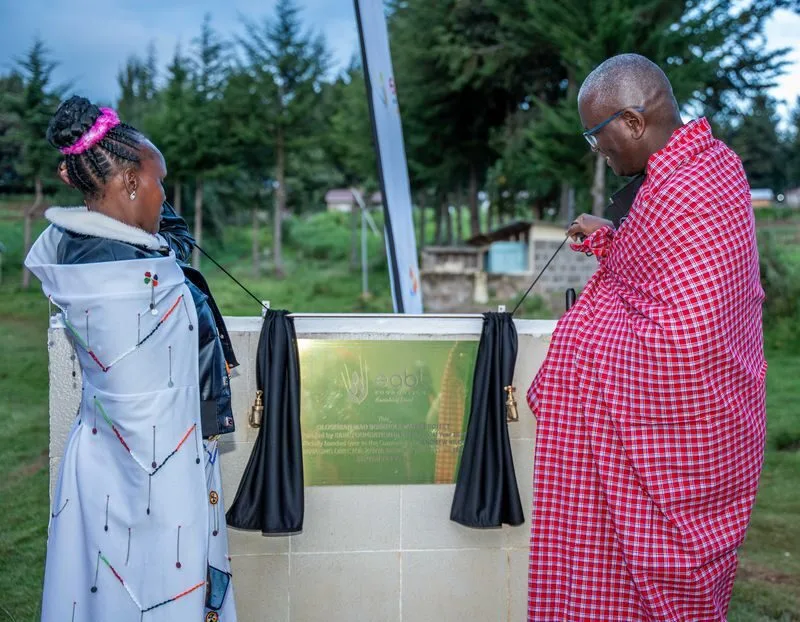
The community water project in Mao, Narok County, is intended to serve more than 8,000 residents.
The project in Mao, Olokurto Division, will supply a school and surrounding households, with solar-powered irrigation expected to support farming.
More than 8,000 residents of Mao in Olokurto Division, Narok County, are expected to gain improved access to clean and safe water after East African Breweries Limited (EABL) commissioned a community water project through Kenya Breweries Limited (KBL).
Implemented in partnership with Ja Gedo Innovations and Frisco Engineering, the initiative targets persistent water shortages affecting homes, schools and livelihoods in the area. It combines water supply infrastructure with a solar-powered irrigation system intended to support agricultural production.
School and households to receive water
The project includes a borehole and an elevated tank with a capacity of 24 cubic metres, mounted on a 12-metre tower. Water will be supplied to Oloserian Mao Secondary and Senior School and a community collection point serving nearby households.
KBL Managing Director Andrew Kilonzo said the investment was intended to address a longstanding gap in reliable water access. He noted that the community had continued to face shortages despite being located within the catchment of Kenya’s second-largest water tower.
Kilonzo said dependable water supplies were important for health and sanitation, as well as education and livelihoods. He described improved access as a necessary part of helping communities realise their potential.
Relief for women and children
Women and children, especially girls, had spent decades travelling long distances to collect water, Kilonzo said. Some families had also been compelled to buy water at high prices to meet their needs.
He added that residents sometimes depended on sources whose cleanliness could not be assured, leaving them exposed to waterborne illnesses, including cholera, dysentery and typhoid. The new infrastructure is intended to provide a more reliable alternative for the community.
Resident Regina Nkoriompai said women and children stood to benefit particularly because they had traditionally shouldered the responsibility of fetching water. She said access to water would also open opportunities for residents to farm and strengthen household livelihoods.
The solar-powered irrigation component is expected to contribute to those agricultural activities, helping households improve food production. Nkoriompai also described the initiative as a move towards stronger community ownership and responsibility for local resources.
Committee to oversee sustainable use
Richard Kishoyan, chairman of the community Water Management Committee, said residents had approached several organisations for help with the water shortage before KBL responded. He called on the community to safeguard the infrastructure so that it could continue serving future generations.
Kishoyan said the 13-member committee had received training to help manage the project and support its sustainability. Its responsibilities include overseeing the water infrastructure and encouraging responsible use of the resource.
The EABL Foundation said the investment was part of its commitment to communities in areas where the company operates. It said its community initiatives seek to strengthen sustainable livelihoods and improve wellbeing.