

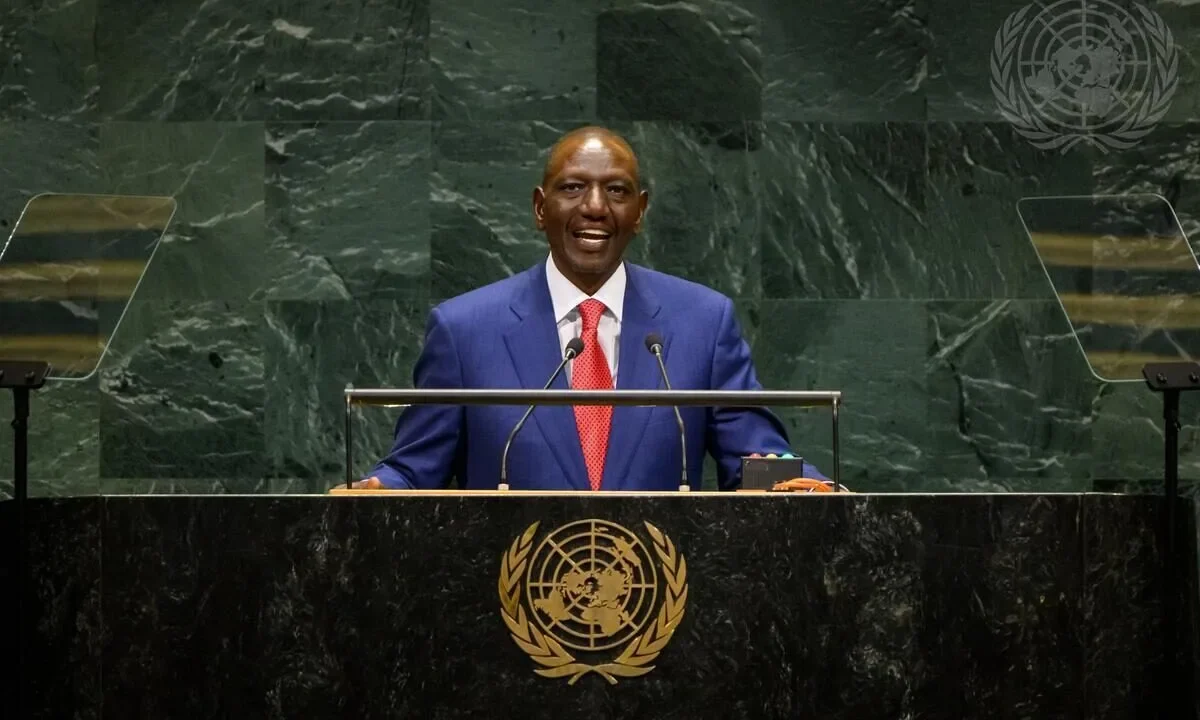
President William Ruto says Africa’s exclusion from permanent Security Council membership reflects wider inequalities in global power and development financing.
President William Ruto has renewed his push for permanent African representation on the United Nations Security Council, arguing that institutions shaped after the Second World War no longer reflect the distribution of power in today’s world.
Addressing the 81st UN General Assembly in New York, Ruto linked reform of the Council to changes in global finance, saying developing countries face unequal influence over both security decisions and the rules governing access to development funding.
He said the UN’s commitment to sovereign equality was undermined by a structure that reserves permanent authority over questions of war and peace for five countries while excluding Africa’s 54 member states.
Africa’s place on the Security Council
Ruto argued that Africa, which accounts for more than a quarter of the General Assembly, remains without a permanent seat despite frequently being affected by Security Council decisions.
The Council has five permanent members — China, France, Russia, the United Kingdom and the United States — and 10 members elected for two-year terms.
The president called for equitable, permanent African representation with the privileges and powers attached to permanent membership. He presented the issue as a measure of whether international institutions can adapt rather than preserve arrangements inherited from 1945.
Ruto also criticised the pace of reform. The General Assembly moved the issue into intergovernmental negotiations in 2008, with formal talks beginning the following year. He noted that negotiations had continued for 17 years without delivering the change Africa seeks.
He pointed to the General Assembly’s 1963 expansion of the Council from 11 to 15 members as evidence that institutional reform is possible. The UN’s 2024 Pact for the Future also identifies Africa’s historical underrepresentation as a priority for redress.
Warning over uneven application of international law
Ruto said confidence in international law was weakening because of inconsistent responses to crises. He argued that selective enforcement damages trust in global institutions and undermines the legitimacy of collective action.
Citing 65 state-based armed conflicts recorded in the previous year, including 13 that reached the scale of war, he said deteriorating security made reform more urgent.
He highlighted conflicts across Europe, the Middle East, the Sahel and the Horn of Africa, saying civilians were bearing the costs through displacement, hunger, damaged infrastructure and disrupted supply chains.
Kenya’s support for multilateralism, he said, should not be understood as support for leaving the current system unchanged. Instead, he called for countries to make international cooperation more effective and consistent.
Debt pressures and development finance
Turning to the international financial system, Ruto said global public debt reached $102 trillion in 2024. He added that 46 developing countries spend more on interest payments than on either health or education.
He argued that countries with significant needs in infrastructure, energy, education and industrialisation often face high borrowing costs that restrict their ability to invest.
Ruto called for multilateral development banks to provide more financing over longer periods, supported by guarantees, risk-sharing arrangements and long-term lending in local currencies.
However, he said international reform must be accompanied by domestic accountability. Governments, he argued, must manage borrowing responsibly, strengthen institutions, develop credible projects, respect contracts and address corruption.
Africa’s industrial and investment potential
Ruto also urged a shift in how Africa participates in the global economy, saying its minerals, agricultural potential, renewable energy resources and young population could support stronger industries and more resilient supply chains.
He said the African Continental Free Trade Area, serving a market of more than 1.5 billion people, should help the continent manufacture more of the goods it currently imports.
As an example of proposed value addition, Ruto cited Kenya’s planned East Africa refinery in Lamu. He said the project was expected to attract about $16 billion in investment and process 700,000 barrels of oil daily.
He also called for greater mobilisation of African capital, estimating that more than $4 trillion was held across pension funds, insurance assets, sovereign wealth funds, banks and other institutions.
His case was that a more industrialised and financially stronger Africa would be better positioned both to shape global decisions and to contribute to food security, clean energy and international trade.