

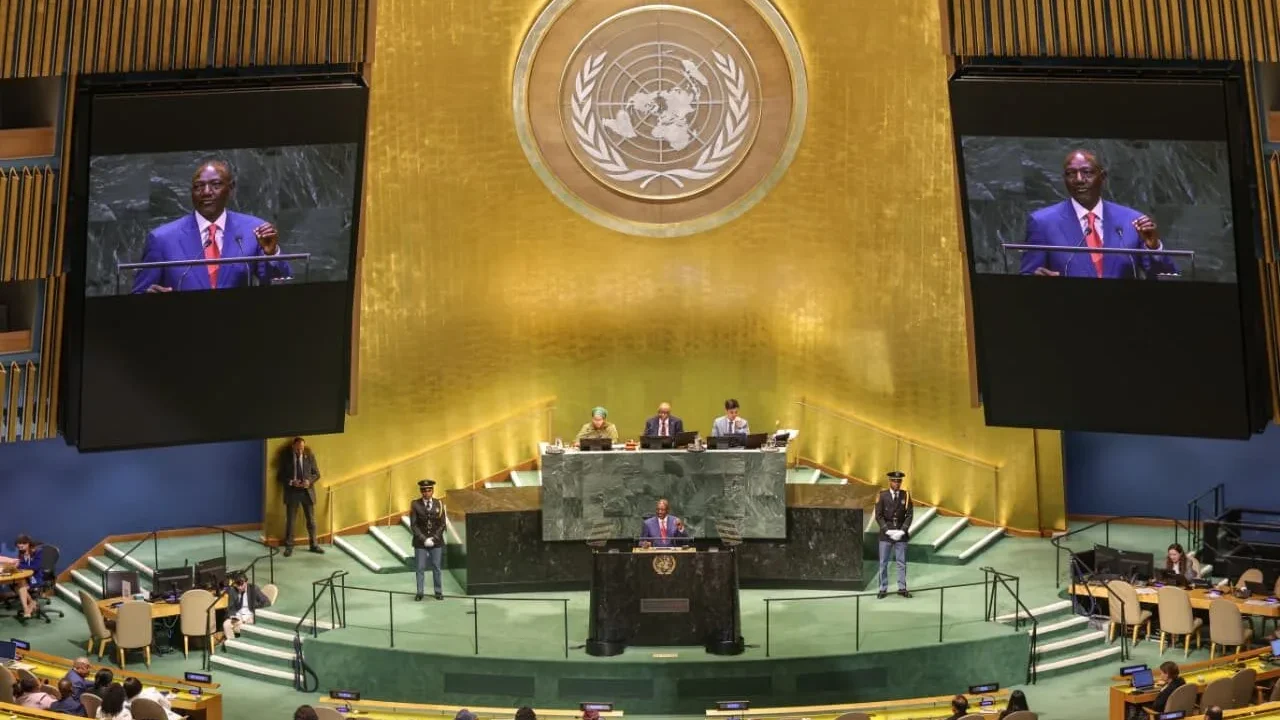
President William Ruto calls for fairer enforcement of international law, permanent African representation and financing reforms to ease developing countries’ debt burden.
President William Ruto has warned that selective enforcement of international law and unequal decision-making power at the United Nations are weakening confidence in the global system.
Addressing the General Debate of the 81st UN General Assembly in New York, Ruto urged countries to close the gap between the principle of sovereign equality and the way international institutions exercise authority.
He argued that the credibility of global rules rests on their consistent application, rather than on declarations of support that change depending on the crisis or countries involved.
The president linked his call for political reform to changes in international financing, saying both were necessary to give developing countries a fairer place in global decision-making and economic development.
Conflicts expose collective security weaknesses
Ruto said institutions established after the Second World War had failed to keep pace with geopolitical changes, leaving the collective security system struggling to respond evenly as conflicts spread.
He cited 65 state-based armed conflicts in the preceding year, including 13 at war scale, and nearly 250,000 deaths from organised violence. Interstate conflicts, he said, had doubled for a second consecutive year, rising from two to eight over two years.
Pointing to crises in Europe, the Middle East, the Sahel and the Horn of Africa, he warned that disputes were increasingly being left unresolved or settled through force rather than effective international action.
Africa’s exclusion from permanent seats
The president focused his criticism on the Security Council, whose five permanent members — China, France, Russia, the United Kingdom and the United States — hold veto power. Its other 10 members are elected for two-year terms.
He contrasted that structure with the 193-member General Assembly, where each country has one vote, arguing that permanent privileges undermine the equality the UN professes.
Africa has 54 UN member states but no permanent Security Council seat. Ruto said this leaves the continent excluded from permanent representation despite its frequent presence on the Council’s peace and security agenda.
He traced the imbalance to the UN’s formation in 1945, when much of Africa remained under colonial rule. UN Secretary-General António Guterres has also characterised the lack of permanent African representation as a historical injustice.
Kenya supports the African common position seeking at least two permanent African seats and five additional non-permanent seats. That position calls for permanent African members to receive full privileges, including veto rights if the veto remains.
Security Council reform discussions have continued through the General Assembly’s intergovernmental negotiations process in 2026. The 2024 Pact for the Future also committed members to reform, explicitly recognising Africa’s historical underrepresentation.
Debt costs and domestic accountability
Ruto said inequalities in global financing were limiting developing countries’ ability to invest in public services and growth.
He cited global public debt of $102 trillion in 2024, saying developing countries held less than a third of the total but paid about $1 trillion in interest. He added that 46 developing countries spent more on interest payments than on health or education.
His proposals included expanded lending by multilateral development banks, stronger guarantees and risk-sharing arrangements, and longer-term loans in local currencies.
However, he also stressed that international reform would not remove governments’ responsibility to improve accountability at home. He called for prudent borrowing, credible projects, dependable contracts, stronger institutions and measures against corruption.
Ruto urged African countries to position themselves as centres of investment, production and growth rather than simply recipients of assistance. He highlighted the continent’s minerals, agricultural capacity, renewable energy, young population and market of 1.5 billion people.
He said African economies should retain more value from their resources by building industries instead of relying on raw-material exports.