

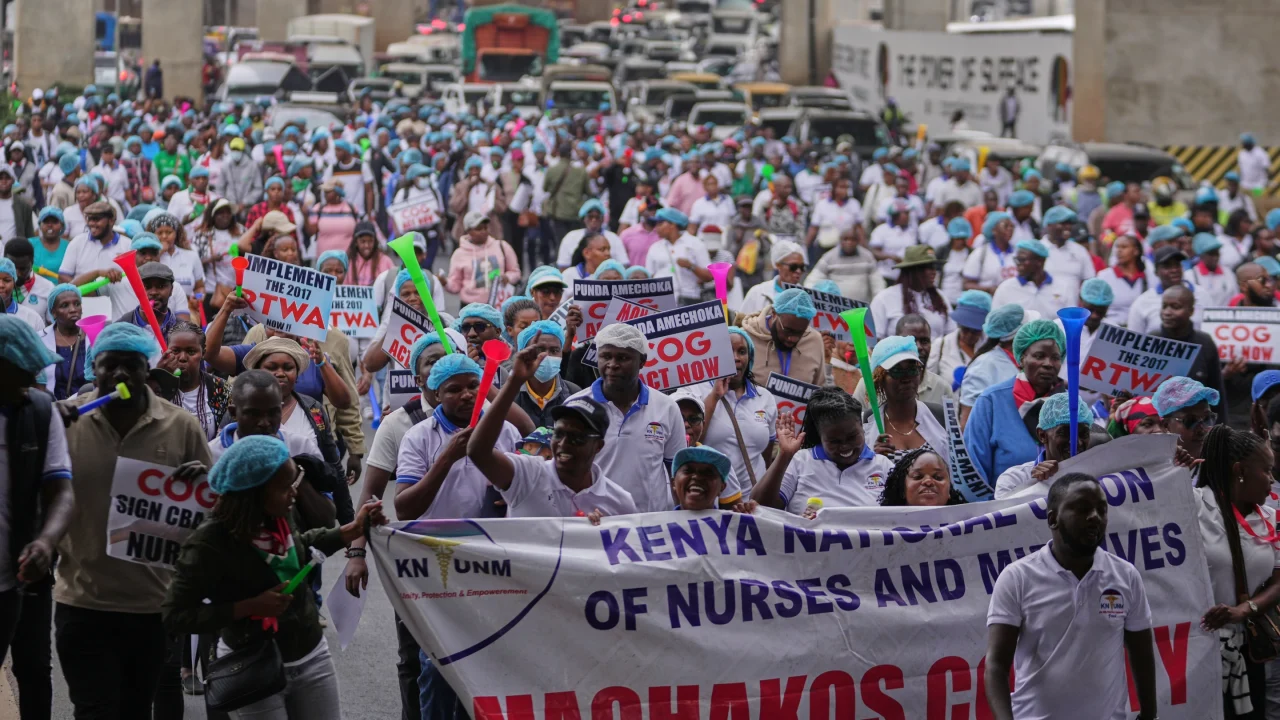
Kenya’s public health sector is facing growing pressure as the nationwide healthcare workers’ strike continues to affect services.
Patients seeking treatment at public hospitals in several parts of the country have experienced delays and reduced access to medical services.
The strike, involving nurses, midwives and clinical officers, has exposed long-standing concerns over employment, career progression and working conditions.
The Kenya National Union of Nurses and Midwives and the Kenya Union of Clinical Officers have continued to push for the implementation of agreements reached with the government.
As the strike continues, concerns are growing over its impact on patients who depend on public health facilities.

Why Healthcare Workers Went on Strike
The strike follows years of concerns raised by healthcare workers over employment and welfare.
One of the main issues is the status of workers recruited under the Universal Health Coverage programme.
Thousands of healthcare workers were employed on contract terms during and after the COVID-19 pandemic.
Unions have called for eligible workers to be transitioned to permanent and pensionable employment.
Healthcare workers have also raised concerns about delayed promotions and career progression.
Some nurses, midwives and clinical officers have remained in the same job groups for years despite gaining experience and additional qualifications.
The unions have also highlighted challenges facing public health facilities.
These include shortages of medical supplies, limited equipment and other resource constraints.
Healthcare workers argue that these challenges affect both their working conditions and the quality of services offered to patients.
Public Hospitals Feel the Impact of the Strike
The continued strike has disrupted operations in several public health facilities.
Patients have been forced to seek alternative treatment, while some facilities have operated with reduced staff.
The situation has placed additional pressure on patients who depend on public hospitals because of their affordability.
County governments and the national government have faced increasing calls to resolve the dispute.
However, disagreements over responsibility and the implementation of employment agreements have continued to delay a broader settlement.
The strike has also raised fresh questions about the relationship between county governments and the national government in managing healthcare services.
Tensions Rise as Strike Continues
Tensions surrounding the strike have also increased in some parts of the country.
In Makueni County, healthcare workers were recently involved in a confrontation during a demonstration in Wote town.
The demonstration later turned chaotic after a clash involving the protesting medics and another group.
Several healthcare workers were reportedly injured during the incident.
Union officials condemned the violence and called for the protection of healthcare workers during demonstrations.
The incident sparked renewed concern about the safety of striking workers and the need for peaceful engagement.
It also increased calls for dialogue between county governments and healthcare unions.
Why Dialogue Could Be Key to Ending the Strike
The continued disruption has highlighted the need for a coordinated approach involving both levels of government.
Healthcare unions have maintained that their concerns require clear commitments and timelines.
Key issues include the transition of eligible UHC workers to permanent and pensionable terms.
Other concerns include the implementation of agreed employment terms and improved career progression.
The condition of public health facilities also remains a major concern for healthcare workers.
A long-term solution will require engagement between healthcare unions, county governments and the national government.
The Council of Governors and the Ministry of Health are expected to play a key role in coordinating discussions.
For patients, a resolution would mean the restoration of critical services in public hospitals.
As negotiations continue, pressure remains on the government and county administrations to reach an agreement.
The outcome of the dispute could also shape future discussions around healthcare employment and the management of Kenya’s devolved health sector.
For now, thousands of patients and healthcare workers remain at the centre of a crisis that requires an urgent and lasting solution.