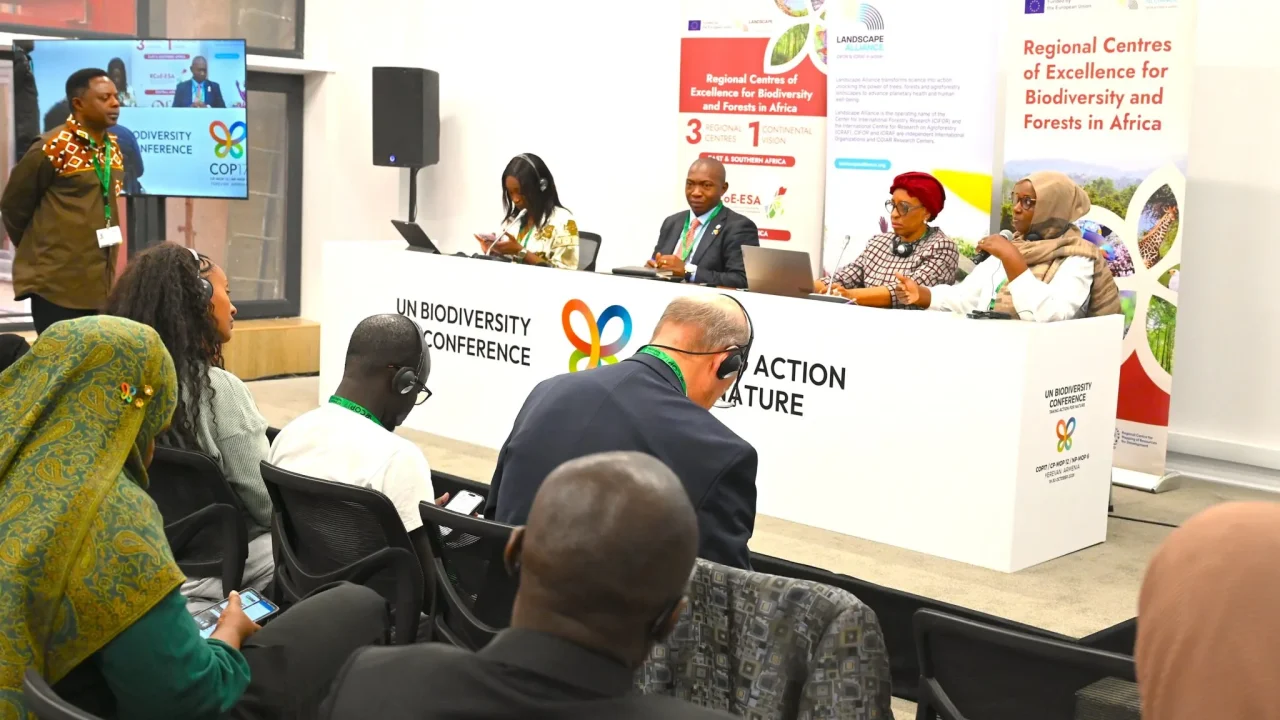
Regional institutions call for stronger support for biodiversity action across Africa.
Regional institutions urge African countries to strengthen monitoring systems, technical skills and long-term funding to turn conservation pledges into action.
African countries need better data, technical expertise and sustainable funding to deliver their biodiversity commitments, regional institutions have warned. They identified weaknesses in monitoring, information sharing and institutional capacity as barriers to implementing the Global Biodiversity Framework.
The warning emerged during discussions at the UN Biodiversity Conference, COP17. Landscape Alliance (CIFOR-ICRAF) convened the engagements through an EU-funded initiative supporting regional biodiversity and forest centres in Africa.
Dr Peter Minang, Africa Director at Landscape Alliance, said countries must move beyond making conservation pledges. They also need institutions, expertise and resources capable of delivering results at scale.

Regional institutions, he added, connect global conservation goals with the practical technical needs of individual countries.
Better data for biodiversity commitments
Participants identified scattered information and inconsistent collection methods as obstacles to using biodiversity data. Some datasets also require validation before officials can use them for policy decisions or national reporting.
Jackline Karimi, a Policy Engagement Specialist at the Regional Centre for Mapping of Resources for Development (RCMRD), highlighted geospatial tools. She said these tools can identify errors, compare new datasets with existing records and help validate information.
However, technology alone cannot address the challenge. Countries also need trained staff and institutions that can maintain systems and apply information to conservation planning.
RCMRD, which serves Eastern and Southern Africa, is helping government agencies, universities and other stakeholders build these skills.
Meanwhile, Marième Diallo, Technical Director at the Centre de Suivi Écologique (CSE), stressed the need for reliable information. She also urged countries to strengthen systems for harmonising, validating and sharing data across institutions and borders.
Long-term funding and regional partnerships
The discussions brought together RCMRD, CSE and the Central African Forest Commission (COMIFAC). CSE serves West Africa, while COMIFAC supports Central Africa.
The three centres support technical and scientific cooperation under the Convention on Biological Diversity. Their work includes geospatial data, biodiversity monitoring, regional assessments and guidance for national implementation.
Valérie Tchuante, a Monitoring and Evaluation Specialist at COMIFAC, called for closer links with universities and research organisations. Such partnerships, she said, would help regional institutions provide sustained technical support to countries.
Participants also stressed the importance of investment beyond individual projects. Long-term funding would help institutions maintain data platforms, update biodiversity information and retain technical expertise.
To address that financing challenge, Minang urged governments, civil society and the private sector to work together. He said their cooperation should support the institutions and technical capacity needed to deliver conservation goals.